All posts

September 23, 2026

Greenwich Village Secrets: Folk Music, Hidden Streets and Literary Ghosts

Greenwich Village is the part of Manhattan that refuses to behave. The streets bend, the numbers stop making sense, and the townhouses feel more like a small 19th-century town than the center of a global city. That's no accident. The Village was a separate settlement long before Manhattan's famous grid was drawn, and it has spent two centuries attracting people who didn't fit in anywhere else: poets, painters, folk singers, activists and comics.

Here are the stories and hidden corners that make the Village worth slowing down for, from the arch where artists once declared independence to the tiny house where one of America's great poets wrote.

Washington Square Park in New York City
Washington Square Park and its famous arch

Washington Square: the arch and the revolution that wasn't

The Washington Square Arch began life as a temporary wood-and-plaster structure, built in 1889 to celebrate the centennial of George Washington's inauguration. New Yorkers loved it so much that architect Stanford White was commissioned to design a permanent marble version, finished in 1892. The two statues of Washington, one as commander in chief and one as president, were added decades later.

The park beneath it has a darker past. Before it became a fashionable square lined with Greek Revival townhouses, much of the land served as a potter's field, a burial ground for the city's poor and victims of epidemics. Tens of thousands of people are believed to still lie beneath the lawns and paths.

The Republic of Greenwich Village

On a winter night in 1917, artist John Sloan, Marcel Duchamp and a handful of friends slipped through a small door in the arch, climbed its internal staircase and, from the top, declared the "Free and Independent Republic of Greenwich Village" with cap guns, balloons and a bottle of wine. The republic lasted about as long as the party, but the Village's reputation as a bohemian enclave was sealed.

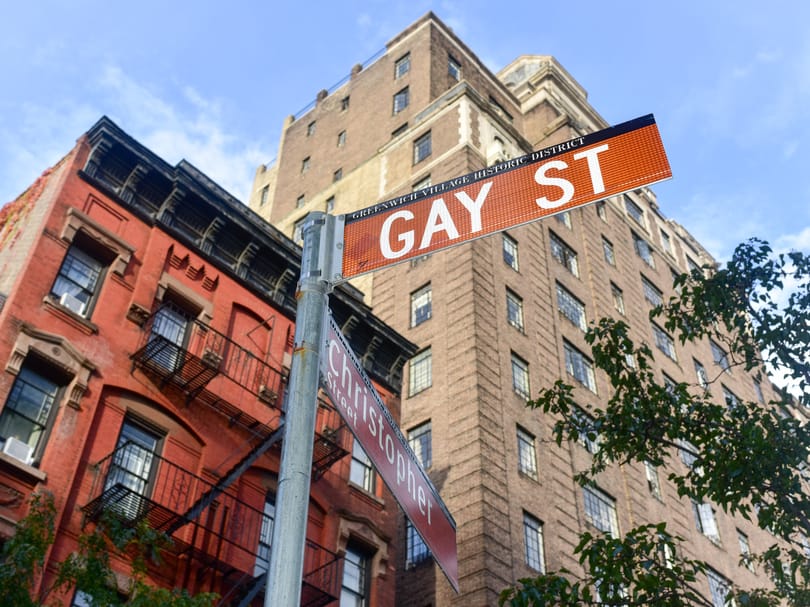
Gay Street, one of the Village's curving side streets

Why the streets make no sense

In most of Manhattan, numbered streets run neatly east to west. In the West Village, West 4th Street somehow crosses West 10th, 11th and 12th Streets. The reason is history: when the city drew up its grid plan in 1811, the Village was already a settled village with its own lanes and property lines, and planners largely left it alone.

The Village grew even faster after 1822, when a yellow fever epidemic sent residents of the crowded lower city fleeing north to its cleaner air. Many of the crooked lanes you'll walk today, like curving Gay Street and tiny Grove Court, date from that era.

Minetta Lane: following a buried stream

Minetta Lane and the neighboring Minetta Street curve for a reason: they trace the course of Minetta Brook, a stream that once ran through the area before it was buried under the growing city. It's one of the clearest examples of old Manhattan's landscape still shaping the streets above. At the corner of MacDougal Street, Minetta Tavern has been pouring drinks since the 1930s.

Patchin Place

Off West 10th Street, look for the iron gate of Patchin Place, a dead-end row of small brick houses. The poet e.e. cummings lived here for decades, and writer Djuna Barnes was a longtime resident too. An old-fashioned cast-iron street lamp still stands at the end of the lane.

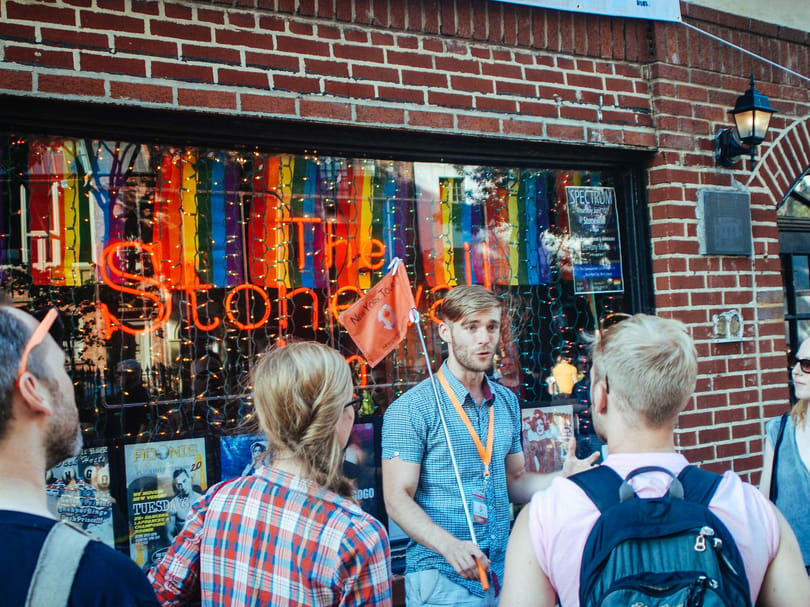
The Stonewall Inn on Christopher Street

Stonewall: where a movement found its moment

In the early hours of June 28, 1969, police raided the Stonewall Inn at 53 Christopher Street, a common occurrence at gay bars at the time. This time, the patrons and neighbors fought back, and the protests continued for several nights. The uprising became a turning point for the LGBTQ rights movement, and the first Pride marches were held a year later to mark the anniversary.

In 2016, the bar, the small triangular Christopher Park across the street and the surrounding streets were designated the Stonewall National Monument, the first national monument dedicated to LGBTQ history. In the park, look for George Segal's white sculptures of two same-sex couples, a quiet and moving place to pause.

MacDougal Street and the folk revival

In the late 1950s and early 1960s, the coffeehouses of MacDougal and Bleecker Streets were the center of the American folk revival. For the price of a cup of coffee, you could hear young singers passing the hat between sets.

  • Cafe Wha? on MacDougal Street is where a 19-year-old Bob Dylan played soon after arriving in the city in January 1961. A few years later, a guitarist calling himself Jimmy James played there too, shortly before the world knew him as Jimi Hendrix.
  • The Gaslight Cafe, a few doors away, was another essential folk stage of the era.
  • Jones Street, a short walk west, is where Dylan and his girlfriend Suze Rotolo were photographed walking arm in arm for the cover of The Freewheelin' Bob Dylan (1963). Fans still recreate the shot.

Local tip: MacDougal is still a nightlife street, home to the Comedy Cellar, live music rooms and late-night slice shops. See the Village's history by day, then come back after dark for a very different neighborhood. Check current show times and book comedy in advance on weekends.

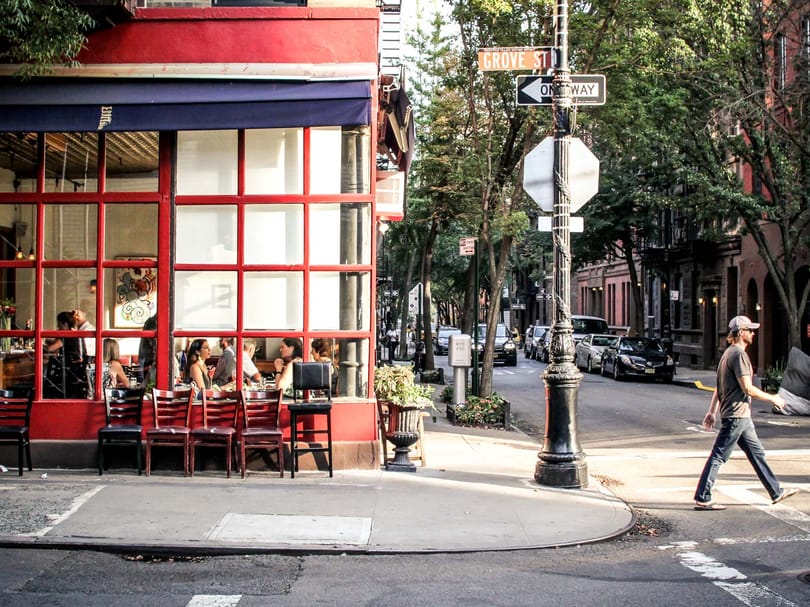
Townhouses on Grove Street

Bedford Street: tiny houses and TV fame

At 75½ Bedford Street stands a house only about nine and a half feet wide, often called the narrowest house in New York. Poet Edna St. Vincent Millay lived here in the early 1920s, around the time she became the first woman to win the Pulitzer Prize for Poetry.

A few doors along, a former speakeasy at 86 Bedford Street famously had no sign. A popular (if unproven) legend says bartenders' slang "86" came from customers being hustled out its back door during police raids.

And at the corner of Bedford and Grove Streets, you may recognize the building at 90 Bedford: its exterior stood in for the apartment building in Friends. It's a private residence, so enjoy the photo from the sidewalk.

More literary ghosts

The Village has been home to so many writers that you can barely walk a block without passing one of their old doorsteps. Henry James was born just off Washington Square in 1843. Mark Twain spent a year at 14 West 10th Street. Welsh poet Dylan Thomas was a regular at the White Horse Tavern on Hudson Street in the weeks before his death in 1953. And the Victorian Gothic Jefferson Market Library, built in the 1870s as a courthouse, is now one of the most beautiful public libraries in the city.

Village secrets to tick off

  • Stand under the Washington Square Arch and find the small door in its side
  • Walk the curve of Minetta Lane
  • Peek through the gate of Patchin Place
  • Pause in Christopher Park at the Stonewall National Monument
  • Grab a coffee on MacDougal Street, then find Cafe Wha?
  • Recreate the Freewheelin' cover on Jones Street
  • Measure up against 75½ Bedford Street
  • Snap the Friends building at Bedford and Grove

See the Village with your own guide

Many of these stories are hidden behind unmarked doors and on side streets you'd never find on your own. On our Private Greenwich Village Walking Tour, a licensed guide leads just your group from Washington Square to Stonewall and the Friends building, at your own pace. Music fans should also look at our private Rock 'n' Roll on the Streets music experience. And if you're continuing downtown afterward, our block-by-block food guide to SoHo, Little Italy and Chinatown picks up where the Village leaves off.

New York Experience is run by ExperienceFirst, a New York tour company founded in 2009.

Greenwich Village FAQs

The exterior used in the show is 90 Bedford Street, at the corner of Grove Street in the West Village. It's a private residential building, so view it from the sidewalk.
Yes. The Stonewall Inn is still an operating bar. The surrounding Stonewall National Monument, including Christopher Park, is open to visitors.
Cafe Wha? still operates as a live music venue on MacDougal Street. Check current show times before you go.
The Village was already settled when Manhattan's grid plan was drawn up in 1811, so its older lanes were largely left in place. That's why West 4th Street can cross West 10th Street.
Allow two to three hours to walk the main sights at a relaxed pace, and longer if you want to stop for coffee, lunch or live music.