All posts

September 23, 2026

The Brooklyn Bridge: the Roeblings, Emily Warren Roebling and how to walk it well

Plenty of bridges carry more traffic, and a few are longer. But no bridge in New York, and arguably no bridge anywhere, has been painted, photographed, filmed and written about quite like the Brooklyn Bridge. When it opened in 1883, it was the longest suspension bridge in the world and the first to use steel wire for its cables, and its twin granite towers were among the tallest structures in the city.

What makes it truly special, though, is the story of the family who built it: a visionary engineer, the son who inherited his dream and paid for it with his health, and a remarkable woman whose role was underplayed for decades. Here's that story, and how to walk the bridge so you see it at its best.
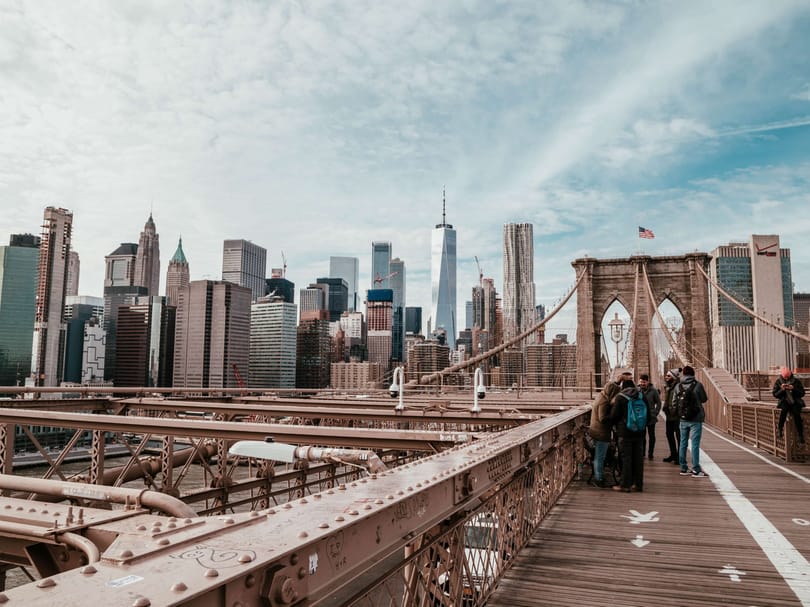
People walking across the Brooklyn Bridge
The raised promenade, designed so walkers could stroll above the traffic

John Roebling: the designer who never saw it built

Before the bridge, the only way between Manhattan and the then-separate city of Brooklyn was by ferry, and in winter ice on the East River could leave boats stranded. John Augustus Roebling, a German-born engineer who had made his fortune manufacturing wire rope in Trenton, New Jersey, had already built acclaimed suspension bridges at Niagara Falls and Cincinnati. He believed he could span the East River, and in 1867 his design was approved.

He never saw a stone laid. In the summer of 1869, while Roebling was surveying the site for the Brooklyn tower near the Fulton Ferry landing, an arriving ferry crushed his foot against the pilings. Several of his toes were amputated, and he refused conventional treatment in favor of his own water cures. He developed tetanus and died a few weeks later. Responsibility for the bridge passed to his 32-year-old son, Washington.

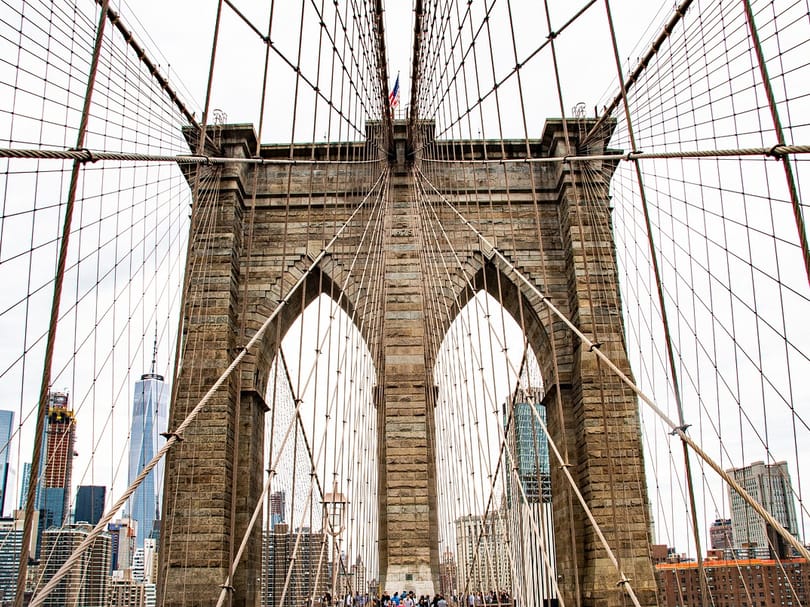
Close up of Brooklyn Bridge in NYC
The bridge's web of steel cables and suspenders

Washington Roebling and the caissons

Washington Roebling, a Civil War veteran who had worked alongside his father, faced the hardest problem first: building foundations for two enormous towers in the bed of a tidal river. The solution was the caisson, a giant bottomless timber box, the one on the Brooklyn side measuring roughly 170 by 100 feet, that was floated into place and sunk. Compressed air was pumped in to keep out water and mud, and men worked inside by lamplight, digging away the riverbed so that the caisson, weighed down by the growing stone tower above it, sank steadily deeper.

The work was brutal and mysterious. Workers coming up from the pressurized chamber were struck by crippling pain, paralysis and sometimes death, a condition then called "caisson disease." Today we know it as decompression sickness, or the bends. Washington spent long hours in the caissons himself, and in 1872 he was badly afflicted. He never fully recovered, and for years he was largely confined to his house in Brooklyn Heights, reportedly following the construction through a telescope from his window.

Emily Warren Roebling: the engineer in all but title

With the chief engineer too ill to visit the site, the job of keeping the project on track fell to his wife, Emily Warren Roebling. At first she carried messages between Washington and his assistant engineers. But to relay his instructions accurately she taught herself the technical subjects that bridge building demanded, from the mathematics of catenary curves to the strength of materials and the construction of cables.

Over roughly a decade, she became the day-to-day link between the chief engineer and everyone else: assistant engineers, contractors, suppliers and the politicians on the bridge's board of trustees. Many people who dealt with her came to believe she understood the project as well as anyone. When critics tried to have her husband removed, she defended his position in person.

When the bridge was finished, Emily Roebling was given the honor of making the first crossing, riding in a carriage and, as the story goes, carrying a rooster as a symbol of victory. At the opening ceremonies, one of the speakers praised her contribution in terms that were striking for the era. Look for the bronze plaque on one of the towers that honors all three Roeblings.

Opening day, a stampede and Barnum's elephants

The bridge opened on May 24, 1883, with fireworks, cannon salutes and President Chester A. Arthur among the crowds. It had taken about 14 years, cost far more than planned and claimed the lives of a number of workers. It had also survived a scandal: a contractor was caught supplying substandard wire for the cables, and extra wires were added to compensate.

Not everyone trusted the new structure. Six days after the opening, a rumor spread among crowds on the promenade that the bridge was collapsing, and the resulting stampede killed 12 people. A year later, in May 1884, showman P.T. Barnum marched a herd of 21 elephants, including his famous Jumbo, across the bridge. It was great publicity for his circus, and a vivid demonstration that the bridge could take the weight.

A secret in the anchorage

In 2006, city workers inspecting the Manhattan side of the bridge found a forgotten Cold War fallout shelter inside the stone anchorage, still stocked with supplies such as water drums, medical kits and survival crackers, stamped with the dates 1957 and 1962. It's not open to visitors, but it's a good reminder that there's more to the bridge than meets the eye.

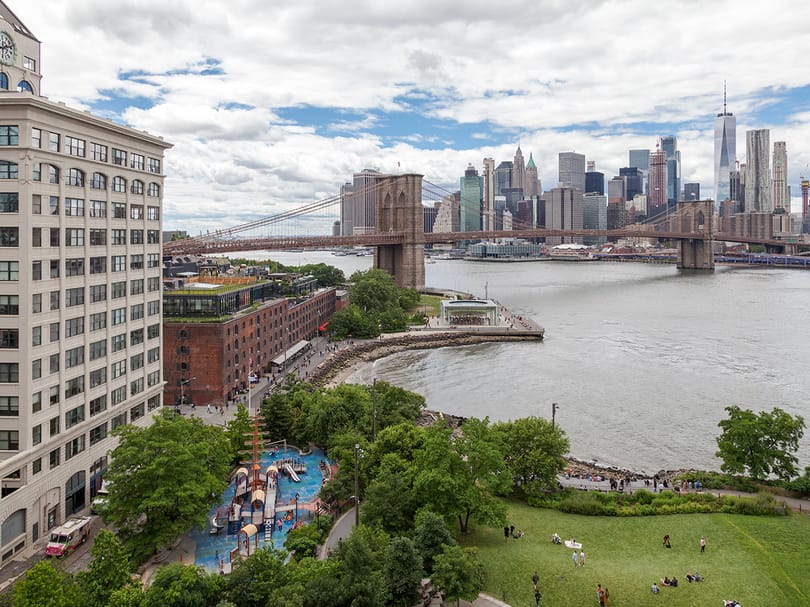
Brooklyn Bridge Park, Manhattan & Brooklyn
Brooklyn Bridge Park, on the Brooklyn waterfront beside the bridge

How to walk the Brooklyn Bridge well

The walk between the entrances is a little over a mile and takes around 30 to 40 minutes at a relaxed pace, longer if you stop for photos, which you will. A few choices make a big difference.

  • Walk toward Manhattan. Start in Brooklyn and you'll have the Lower Manhattan skyline in front of you the whole way. The A and C trains to High Street drop you close to the Brooklyn entrance, and you'll finish near the Brooklyn Bridge-City Hall station.
  • Go early. By late morning the promenade can be very crowded, especially on weekends. Sunrise and early morning are calmest, and the light on the towers is beautiful.
  • Stay on the pedestrian path. Since 2021, cyclists have had their own protected lane on the roadway level, which has made the promenade more comfortable for walkers. Still, keep an eye out for people stopping suddenly to take pictures.
  • Look up at the towers. The pointed Gothic arches were a deliberate choice, meant to give the bridge the dignity of a cathedral.

Before or after: DUMBO and the waterfront

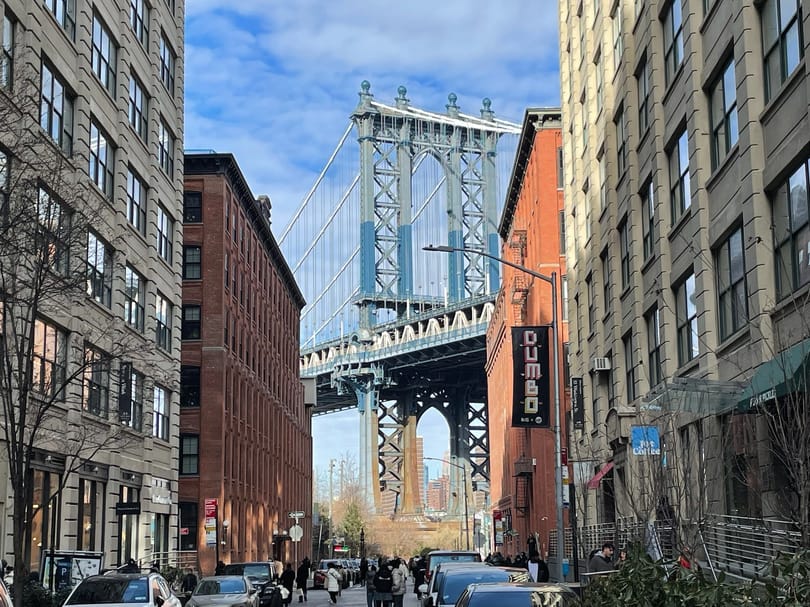
The neighborhood at the Brooklyn end of the bridge is DUMBO, short for "Down Under the Manhattan Bridge Overpass." Its cobbled streets and converted warehouses are full of cafés, bakeries and galleries. Head to Washington Street for the famous view of the Manhattan Bridge framed between old brick buildings, then walk down to Brooklyn Bridge Park for lawns, piers and a vintage carousel beside the water. The views of the bridge you just crossed are superb from here, especially toward sunset.

The Brooklyn Bridge seen between the buildings of DUMBO

Brooklyn Bridge walk checklist

  • Start in Brooklyn so the skyline is ahead of you
  • Go early morning to beat the crowds
  • Find the plaque honoring John, Washington and Emily Roebling
  • Stand beneath a tower and look up at the Gothic arches
  • Spot the Statue of Liberty from the promenade on a clear day
  • Walk down to DUMBO and Washington Street
  • Catch sunset over Manhattan from Brooklyn Bridge Park

Make a day of it in Brooklyn

Crossing the bridge is the perfect appetizer for a food-focused afternoon. Our Guided DUMBO Foodie Experience explores the neighborhood at the Brooklyn end one tasting at a time. To see more of the outer boroughs, join our Brooklyn, Bronx and Queens bus tour, or travel in comfort with Brooklyn, Bronx and Queens by Private Luxury Car. And for more reasons to leave Manhattan, read why Brooklyn, the Bronx and Queens deserve a day.

New York Experience is run by ExperienceFirst, a New York tour company founded in 2009.

Brooklyn Bridge FAQs

The walk is a little over a mile and takes about 30 to 40 minutes at a relaxed pace, or up to an hour if you stop often for photos.
Most people prefer starting in Brooklyn and walking toward Manhattan, so the skyline is in front of you the whole way.
Yes. The pedestrian promenade is free and open to the public.
Emily Warren Roebling was the wife of chief engineer Washington Roebling. When he was disabled by caisson disease, she learned the engineering involved and acted as his link to the site for years, playing a vital role in completing the bridge.
The Brooklyn Bridge opened on May 24, 1883, after about 14 years of construction.
Early morning is best for smaller crowds and soft light. Sunset is beautiful too, but expect it to be busy.