All posts

September 23, 2026

Beyond the Charging Bull: 10 Wall Street Stories Most Visitors Miss

Most visitors to Wall Street follow the same script: a selfie with the Charging Bull, a quick look at the flag-draped New York Stock Exchange, and a dash to the next attraction. That’s a shame, because the half-mile around Wall Street packs in more American history per block than almost anywhere in the country. The first president took his oath here. The stock market was born under a tree here. And one of the deadliest attacks on the city before 9/11 left scars you can still touch.

Here are ten stories our guides love to tell, and exactly where to look for them.

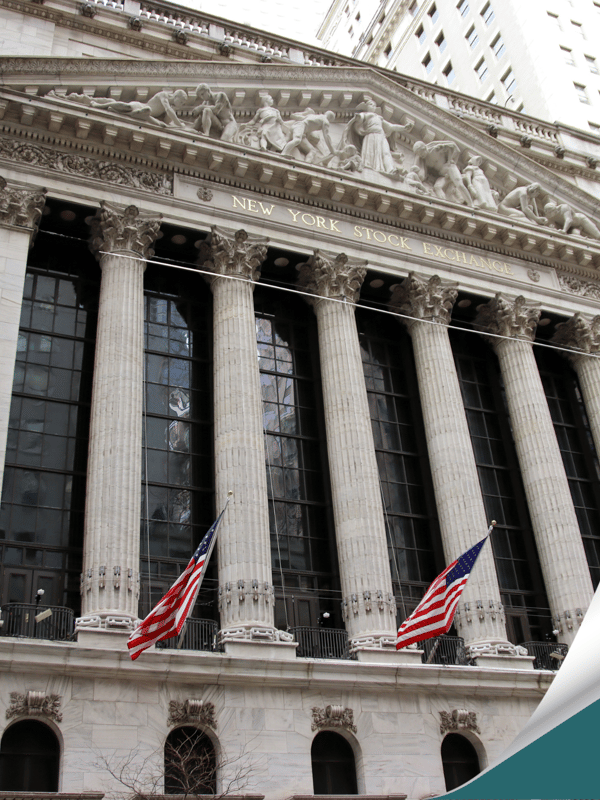
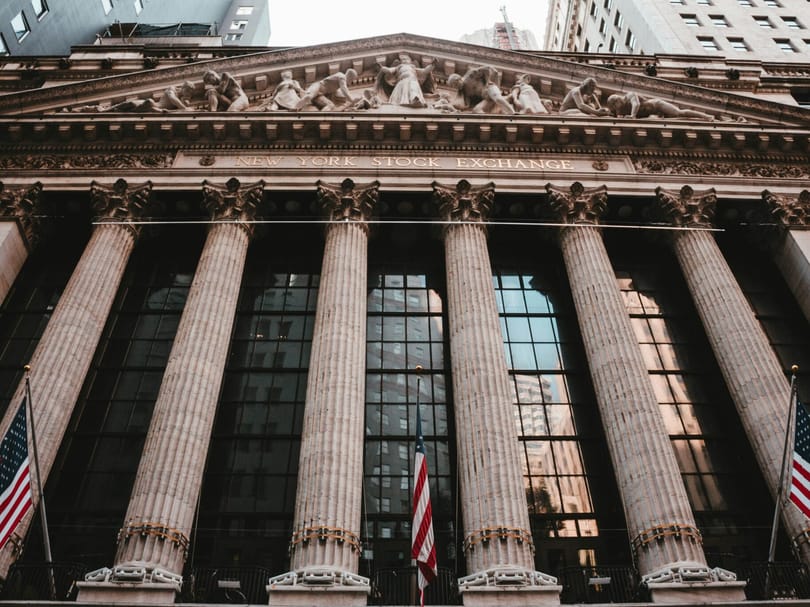
Entrance of New York Stock Exchange
The New York Stock Exchange on Broad Street, just around the corner from the tree where it all began.

1. There really was a wall

Wall Street is named for an actual wall. In the 1650s, the Dutch colony of New Amsterdam, worried about an attack from English New England, built a timber palisade across the island at what was then its northern edge. It ran roughly from the East River to the Hudson along today’s street. The wall never saw a serious battle, and after the English took over the colony it was taken down by the end of the 1690s. The street that grew up along its path kept the name.

The area also carries a harder history. In 1711 the city established an official market for buying and selling enslaved people at the foot of Wall Street near the East River. A historical marker installed in 2015 at Wall and Water Streets now acknowledges the site, a sobering stop that many walking tours skip.

2. The stock market began under a tree

On May 17, 1792, two dozen brokers signed a short agreement to trade only among themselves and to charge a fixed commission. Tradition holds that they met beneath a buttonwood (sycamore) tree outside 68 Wall Street, which is why it’s remembered as the Buttonwood Agreement. That handshake deal is considered the founding moment of what became the New York Stock Exchange, which adopted a formal constitution in 1817. Look for the plaque, and the replacement buttonwood trees that have been planted in the area over the years.

3. Washington’s inauguration happened here, not in D.C.

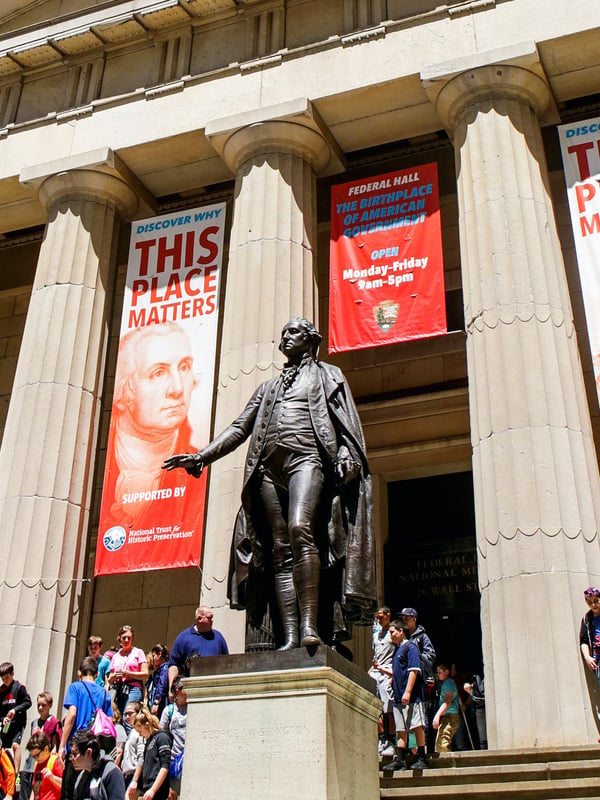
Washington, D.C. didn’t exist yet in 1789, and New York was the first capital under the Constitution. On April 30, 1789, George Washington stood on the balcony of Federal Hall, at the corner of Wall and Nassau Streets, and took the oath of office as the first President of the United States. The first Congress met in the same building and approved the amendments that became the Bill of Rights.

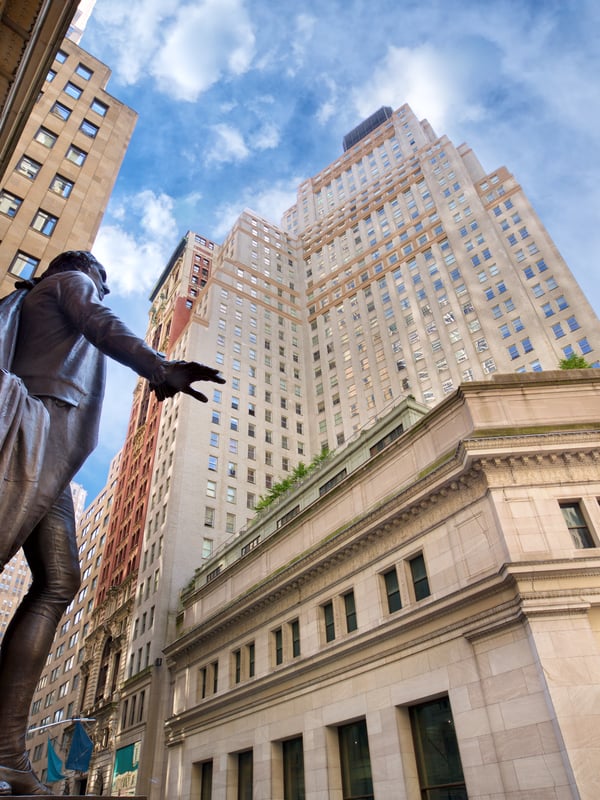
The building Washington knew was demolished in 1812. The Greek Revival temple you see today opened in 1842 as the U.S. Custom House. John Quincy Adams Ward’s bronze statue of Washington on the front steps, unveiled in 1883, marks roughly where he stood. Inside, you can see a fragment of the original balcony. The Bible he swore on belongs to St. John’s Masonic Lodge and still occasionally goes on display.
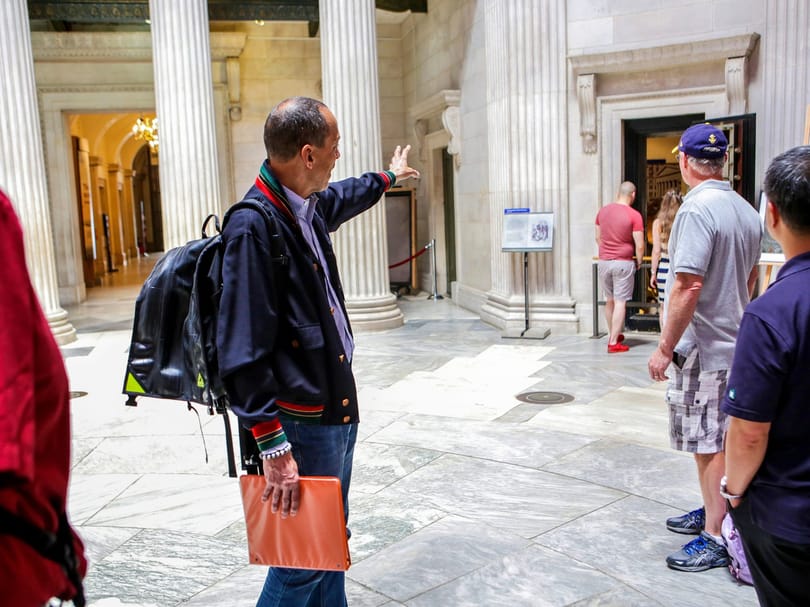
Tour Group in Federal Hall
Inside Federal Hall, where the story of the first federal government is told.

Insider tip

Federal Hall is run by the National Park Service and is usually free to enter on weekdays, which makes it one of the best-value stops in the Financial District. Check current opening days before you go, as they can change. Stand on the steps beside Washington’s statue and look straight down Broad Street: the New York Stock Exchange fills the view, a neat picture of political and financial power staring at each other.

4. The bomb scars on 23 Wall Street

Just before noon on September 16, 1920, a horse-drawn wagon parked opposite the headquarters of J.P. Morgan & Co. at 23 Wall Street exploded. The bomb, packed with dynamite and iron sash weights, killed 38 people and injured hundreds more in the busiest financial crossroads in America. Investigators suspected Italian anarchists, but no one was ever convicted, and the Wall Street bombing remains officially unsolved.

The Morgan bank reopened the next day and chose not to repair the damage to its limestone facade. Walk up to the Wall Street side of the building (the one with no name on it, a famous Morgan understatement) and look for the shallow pockmarks in the stone. They’re a century-old crime scene hiding in plain sight.

5. Hamilton rests at the top of the street

Wall Street runs downhill from Trinity Church to the East River, and the church is where the street’s patron saint of finance is buried. Alexander Hamilton, the first Secretary of the Treasury, who designed the young nation’s financial system and helped found the Bank of New York in 1784, lies in the churchyard beside his wife, Eliza. He was brought here in 1804 after his fatal duel with Aaron Burr across the river in Weehawken.

The current Gothic Revival church, designed by Richard Upjohn, was completed in 1846, and its spire made it the tallest building in New York until 1890. Its churchyard is one of the oldest in the city; look for the gravestones worn smooth by nearly three centuries of weather.

Trinity Church on the Self-Guided Hamilton Walking Tour in NYC
Trinity Church stands at the head of Wall Street; Alexander Hamilton is buried in its churchyard.

6. The Stock Exchange facade tells a story

The New York Stock Exchange building at 18 Broad Street opened in 1903, designed by George B. Post with six huge Corinthian columns. Look up at the pediment: the marble sculpture group, titled Integrity Protecting the Works of Man, was designed by John Quincy Adams Ward (the same sculptor as the Washington statue at Federal Hall) with Paul Wayland Bartlett. The original marble figures deteriorated and were replaced with lighter replicas in the 1930s. The trading floor has been closed to the public since 2001, so the facade is as close as most visitors get.

7. Delmonico’s and the birth of American fine dining

A few blocks away, where Beaver and South William Streets meet, stands Delmonico’s. The Delmonico family, immigrants from Switzerland, began with a small café and pastry shop in the 1820s and went on to create what is widely called America’s first fine-dining restaurant, with printed menus and private dining rooms. The kitchen is credited with the Delmonico steak and Lobster Newberg, and is closely tied to early versions of Eggs Benedict and Baked Alaska. Legend has it the columns flanking the entrance came from Pompeii. The restaurant has opened and closed a few times in recent years, so check current hours if you want to eat there.

8. Washington said goodbye at Fraunces Tavern

Head south to Pearl and Broad Streets to find Fraunces Tavern, where on December 4, 1783, George Washington bade an emotional farewell to the officers of the Continental Army before resigning his commission. In the early years of the republic the building also housed government offices. Much of what you see today is a careful 1907 reconstruction, and the upper floors now hold a museum about the Revolutionary era.

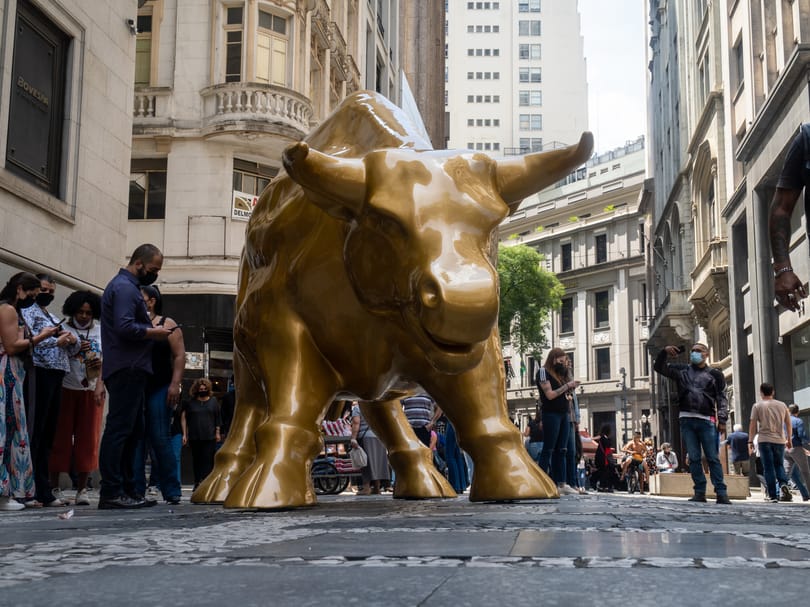
The Charging Bull at Bowling Green, originally dropped off without permission in 1989.

9. The Bull was a guerrilla art stunt

The Charging Bull wasn’t commissioned by anyone. In December 1989, sculptor Arturo Di Modica spent his own money casting the bronze and trucked it overnight to the front of the Stock Exchange as a gift to the city after the 1987 market crash. Police removed it, public affection brought it back, and it has stood at Bowling Green ever since, technically on a temporary permit.

Fearless Girl, by Kristen Visbal, arrived in March 2017, facing down the Bull on the eve of International Women’s Day. After debates over what she did to the Bull’s meaning, she was moved in 2018 to stand opposite the Stock Exchange instead. Seeing both is easy; seeing the Bull without a crowd means getting there early in the morning.

10. There’s a mountain of gold under Liberty Street

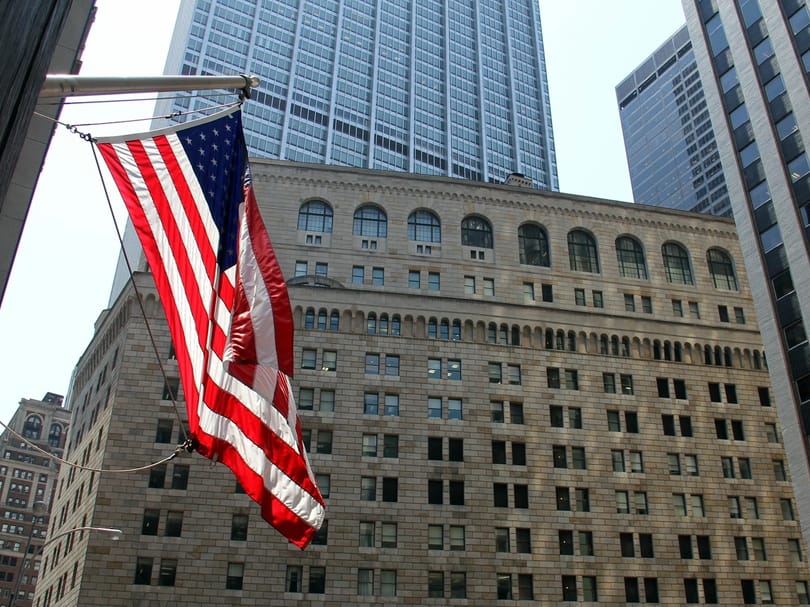
A block north of Wall Street, the fortress-like Federal Reserve Bank of New York at 33 Liberty Street looks like a Florentine palazzo, and it keeps its biggest secret below ground. Its gold vault sits about 80 feet beneath the street, resting on Manhattan bedrock, and holds one of the largest stores of monetary gold in the world, most of it owned by foreign governments and central banks. Public access has varied over the years; check the New York Fed’s website for current visitor information.

The Fed also played a leading role during the 2008 financial crisis, when Lower Manhattan became the center of a global emergency. Our Private Financial Crisis Tour walks you through what happened on these streets, block by block.

American Flag in front of Federal Reserve Building in Wall Street NYC (1)
The Federal Reserve Bank of New York guards a gold vault about 80 feet below the street.

A self-guided Wall Street route

  • Start at Trinity Church and Hamilton’s grave at Broadway and Wall Street.
  • Walk down Wall Street to Federal Hall and Washington’s statue.
  • Look across at 23 Wall Street for the 1920 bomb scars.
  • Turn onto Broad Street for the Stock Exchange facade and Fearless Girl.
  • Detour to 68 Wall Street for the Buttonwood Agreement plaque.
  • Finish at Wall and Water Streets for the slave market marker, then Delmonico’s and Fraunces Tavern.
  • Save the Charging Bull at Bowling Green for early morning or last thing.
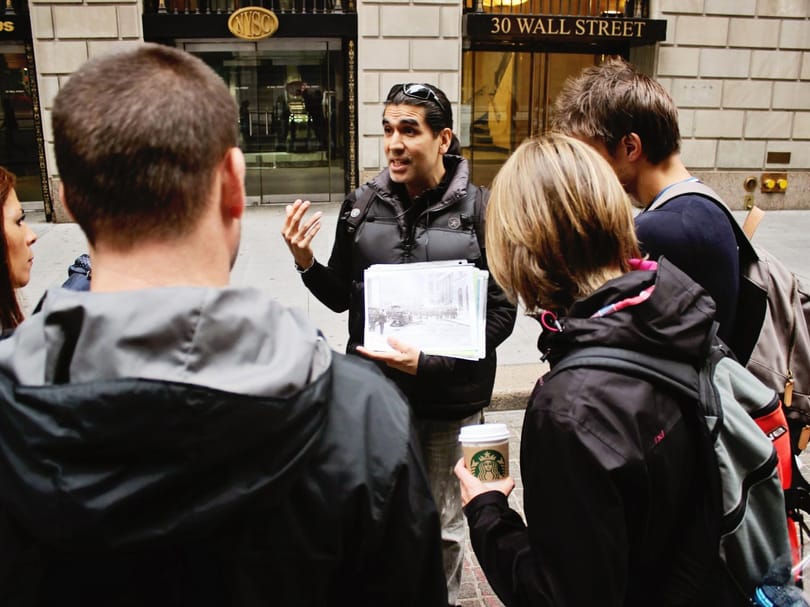
Wall Street tour guide with small group
A guided Wall Street tour in the Financial District.

Hear it from someone who knows the Street

You can find every one of these spots on your own, but the stories land differently when someone connects them. Our Wall Street Insider Tour covers the essentials with a local guide, while Wall Street With a Trader is a private experience led by someone who has worked in the markets.

New York Experience is run by ExperienceFirst, a New York tour company founded in 2009, and Lower Manhattan remains one of our favorite neighborhoods to share.

Wall Street FAQs

Not as a regular visitor. The public gallery closed after September 11, 2001, and the trading floor is not open for tours. You can see the famous facade on Broad Street, and a guided tour will explain what happens inside.
It follows the line of a defensive timber wall built by the Dutch colony of New Amsterdam in the 1650s. The wall was removed by the end of the 1690s, but the name stuck.
On the balcony of Federal Hall at Wall and Nassau Streets, on April 30, 1789. The current building dates from 1842, and a statue of Washington marks the spot.
Yes. The facade of 23 Wall Street, the former J.P. Morgan headquarters, still has shallow pockmarks from the blast. The bank chose not to repair them.
In the churchyard of Trinity Church, at Broadway and Wall Street, alongside his wife Eliza.
The key sights are within a few blocks. Allow about two hours to see them properly on foot, or join a guided walking tour of a similar length.