All posts

September 23, 2026

Central Park's hidden history: Seneca Village, the Greensward Plan and the park's secret corners

Most visitors experience Central Park as a pause button: a green escape from the traffic, where you can row a boat, eat a hot dog on a bench and forget you're in the middle of Manhattan. That feeling is exactly what its designers intended. But the "nature" you're enjoying is one of the most ambitious pieces of engineering in 19th-century America, and the land beneath it has a history that was, for more than a century, largely left out of the story.

Here's the Central Park most people walk straight past: the Black village that was cleared to build it, the clever design tricks that hide the city from view, and the quiet corners even many New Yorkers have never found.

A group of people standing Bethesda Terrace
Bethesda Terrace, the formal heart of Olmsted and Vaux's design
Central Park in Fall
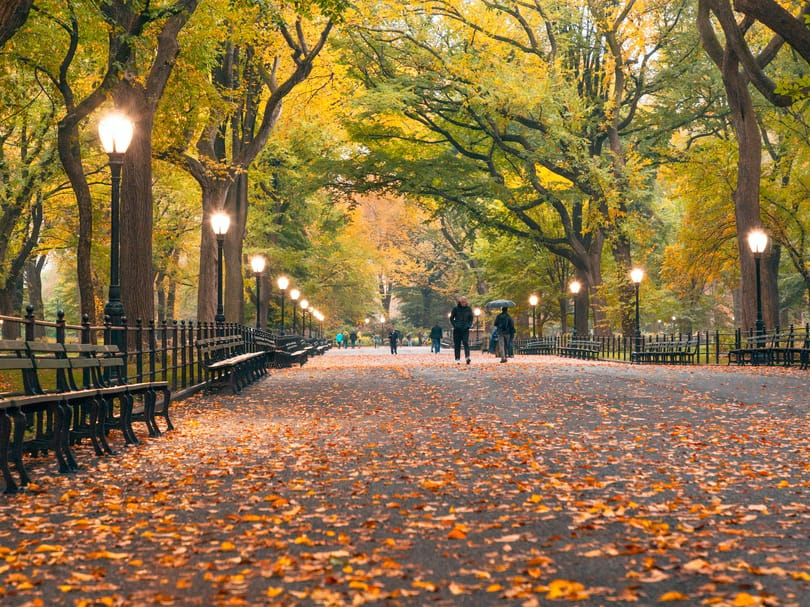
Autumn in Central Park

Seneca Village: the community beneath the park

Long before the park existed, the land between roughly West 82nd and West 89th Streets, near today's Eighth Avenue edge, was home to Seneca Village. It began in 1825, when Andrew Williams, a young African American shoe shiner, bought land there from a white couple, John and Elizabeth Whitehead. Other Black New Yorkers followed, buying lots of their own at a time when owning property was rare and precious.

Owning land mattered for another reason. Under New York's rules at the time, Black men could vote only if they owned property worth at least $250, so Seneca Village was, in a very real sense, a path to citizenship. By 1855, the village had around 225 residents, roughly two-thirds of them African American, with Irish and German immigrants living alongside them. There were churches, a school and cemeteries.

In 1857, the city took the land by eminent domain for the new park. Residents were paid for their property and forced to leave, and the village disappeared from the map and, for generations, from memory.

How to find Seneca Village today

Enter the park at West 85th Street and walk toward the playground and the slopes just inside the wall. Outdoor interpretive signs now tell the village's story, and archaeologists who excavated here in 2011 recovered thousands of everyday objects, from pieces of ceramic dishes to a child's shoe. There's nothing grand to see, and that's the point: stand still for a minute and picture the homes, gardens and church steps that were once here.

The Greensward Plan: a landscape built to look accidental

In 1858, the park's commissioners held a public design competition. The winning entry, called the Greensward Plan, came from Frederick Law Olmsted, a writer and farmer with no formal design training, and Calvert Vaux, an English-born architect. Their idea was radical in its simplicity: give ordinary New Yorkers, most of whom couldn't afford a trip to the countryside, a sequence of pastoral scenes that felt entirely natural.

None of it was natural. The site was rocky, swampy and cut up by ridges of bedrock. Crews blasted rock, drained wetlands, moved enormous quantities of soil and planted hundreds of thousands of trees and shrubs. Lakes that look as if they've always been there were dug by hand. Meadows that seem to roll on forever were graded to hide the buildings at their edges. It took well over a decade of work, and the park reached its current northern boundary at 110th Street after an extension in the 1860s.

The trick you walk over without noticing

Olmsted and Vaux's smartest idea is one most visitors never spot. The competition required roads to carry crosstown traffic through the park, which would have sliced it into pieces. Instead of running those roads across the surface, the designers sank four transverse roads below ground level, hidden in cuttings and screened by planting. Buses and taxis cross the park all day, and from the paths above you barely know they're there.

They applied the same thinking inside the park, separating carriage drives, bridle paths and footpaths so that each could flow without crossing the others. Where paths meet, one passes over or under the other on a bridge or arch, and Vaux designed dozens of them, each one different. Look out for cast-iron Bow Bridge over the Lake, one of the most photographed spots in the city.
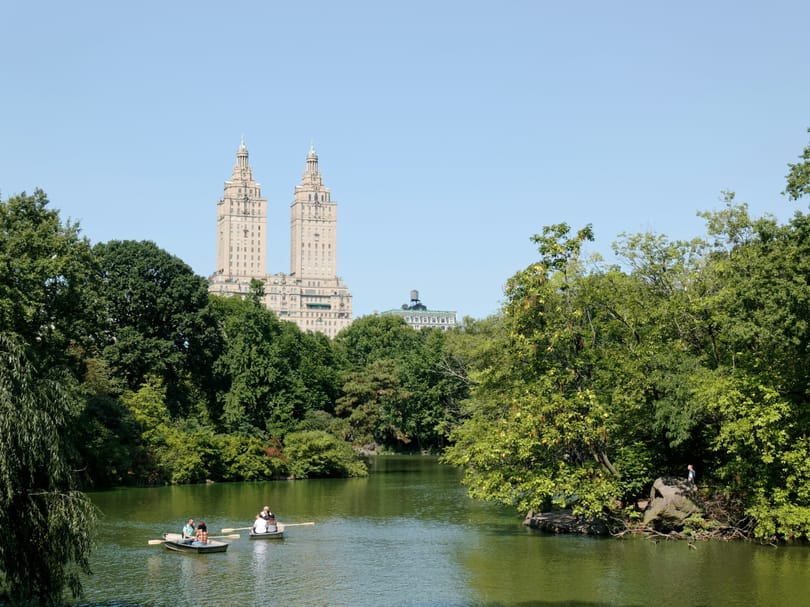
People boating in the Lake in Central Park NYC
Rowboats on the Lake, dug by hand in the 1850s

Bethesda Terrace and the angel with a message

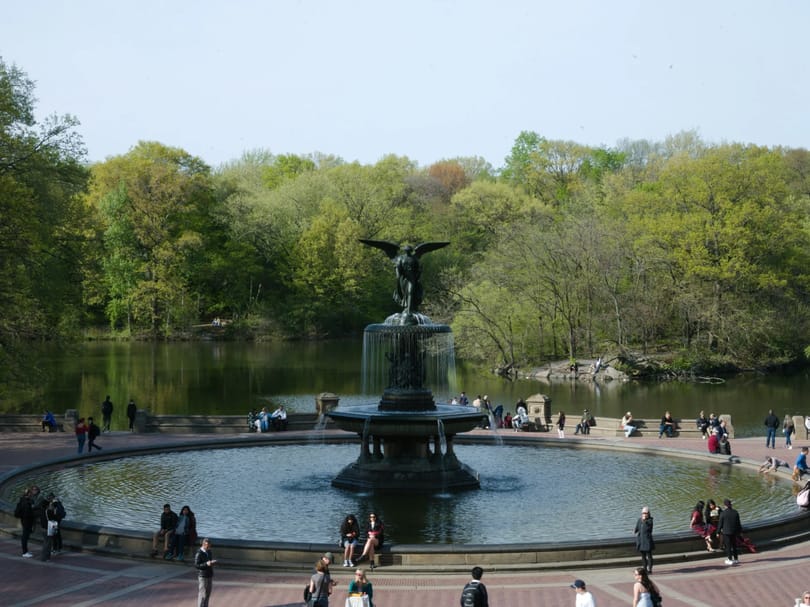
Olmsted and Vaux allowed themselves one formal set piece: Bethesda Terrace, a grand double staircase leading down to the Lake. Walk through the arcade beneath the road and look up at the ceiling, lined with intricately patterned tiles that were restored in the 2000s after decades hidden under grime.

At the center of the terrace stands the Angel of the Waters, unveiled in 1873. Its sculptor, Emma Stebbins, was the first woman commissioned to create a major public artwork in New York City. The angel has a very New York meaning: it celebrates the Croton Aqueduct, which brought clean drinking water to the city in 1842 and helped end the deadly cholera outbreaks of earlier decades.

The park's secret corners

Central Park covers more than 800 acres, and most visitors stick to the southern end. Head north or off the main paths and you'll find places that feel a world away.

  • The Blockhouse. Hidden on a rocky bluff in the North Woods, near West 109th Street, this small stone fort was built in 1814, during the War of 1812, to defend the city from a British attack that never came. It's the oldest surviving building in the park.
  • The Ravine and the Loch. Also in the North Woods, a stream tumbles over small waterfalls through a wooded valley. Olmsted and Vaux wanted it to feel like the Adirondacks, and on a quiet weekday morning it genuinely does.
  • Hallett Nature Sanctuary. This four-acre woodland peninsula near the Pond at the park's southeast corner was fenced off for decades and left to grow wild, before opening to the public on a limited schedule in 2016. Check current opening times before you go.
  • Belvedere Castle. Vaux's miniature castle on Vista Rock was designed as a viewpoint and folly. Since 1919 it has also been home to weather instruments, which is why you'll hear forecasters quote readings "in Central Park."
  • Cleopatra's Needle. Behind the Metropolitan Museum of Art stands an Egyptian obelisk around 3,500 years old, the oldest human-made object in the park. It arrived in New York in 1880 after an epic journey by sea.
  • The Conservatory Garden. Enter at Fifth Avenue and 105th Street through the ornate Vanderbilt Gate, which once stood outside a Vanderbilt family mansion in Midtown. Inside is the park's only formal garden, laid out in Italian, French and English styles.

Local tip: Look down as well as up. The dark, glittering rock outcrops you'll see everywhere are Manhattan schist, and many are marked with long parallel scratches. Those grooves were carved by glaciers during the last Ice Age, and they point in the direction the ice was moving.

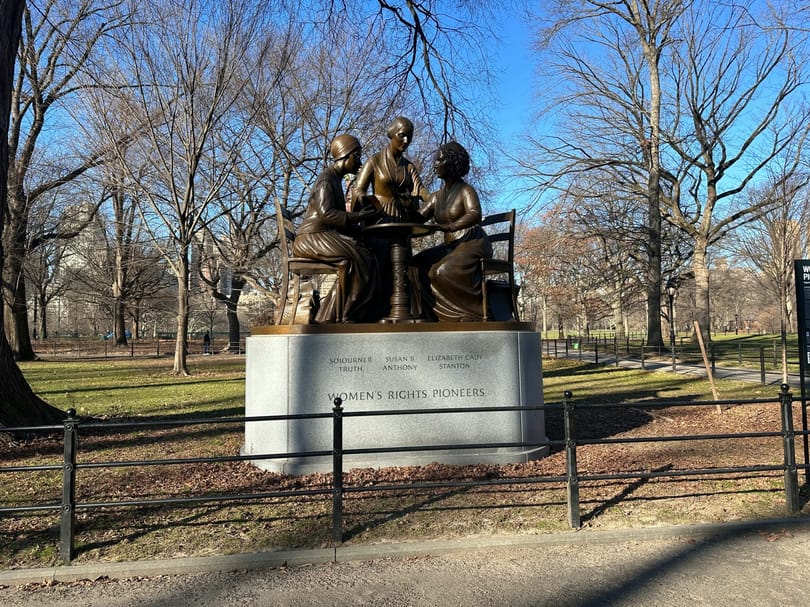
Women's Rights Pioneers statute, Mall in Central Park
The Women's Rights Pioneers Monument on the Mall

Statues, stories and a long-overdue first

The tree-lined Mall, with its Literary Walk of writers' statues, is the park's grand promenade. For most of the park's history, the only women depicted in its statues were fictional characters, such as Alice in Wonderland and Shakespeare's Juliet. That changed in August 2020, when the Women's Rights Pioneers Monument was unveiled on the Mall, showing Sojourner Truth, Susan B. Anthony and Elizabeth Cady Stanton in conversation. It was the park's first statue of real women.

On the West Side near 72nd Street, Strawberry Fields is a quiet memorial to John Lennon, who lived across the street at the Dakota. Its black-and-white Imagine mosaic was a gift from the city of Naples, Italy, and it's rarely without flowers, candles or someone quietly playing a guitar.

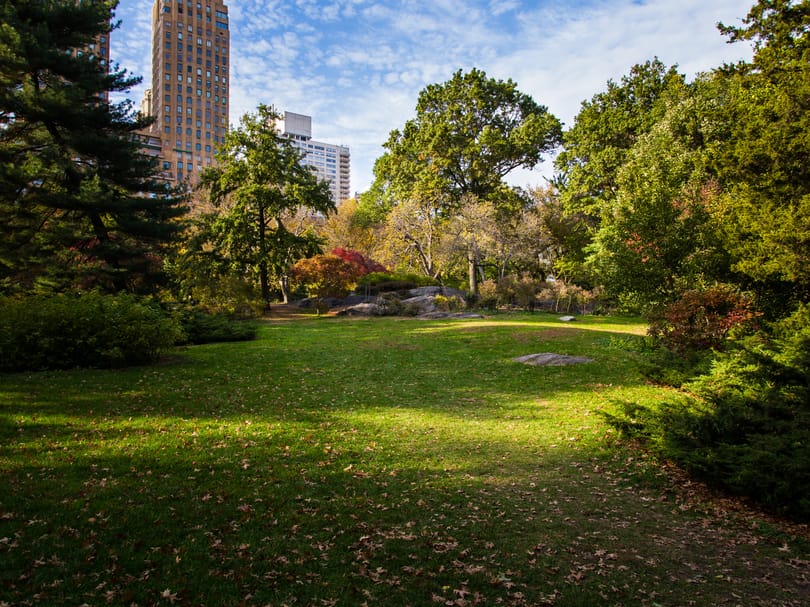
A quiet lawn in Central Park on an autumn afternoon

Central Park history to tick off

  • Read the Seneca Village signs near the West 85th Street entrance
  • Spot a sunken transverse road from a bridge above
  • Cross Bow Bridge over the Lake
  • Look up at the tiled ceiling of the Bethesda Terrace arcade
  • Find the Angel of the Waters and remember the Croton Aqueduct
  • Climb to the Blockhouse in the North Woods
  • Check the opening times and visit the Hallett Nature Sanctuary
  • Walk through the Vanderbilt Gate into the Conservatory Garden
  • Find glacial scratches on a schist outcrop

Pair the park with a guided experience

Central Park is best explored slowly, but it's also the perfect companion to some of the city's best experiences. The Metropolitan Museum of Art sits right on the park's eastern edge, so our Met in Depth guided experience or Met Highlights Tour makes an easy half day with a walk to Cleopatra's Needle afterward. If you'd rather see the park as part of a bigger picture of Manhattan, Manhattan by Private Luxury Car gives your group its own guide and vehicle. And if it's your first visit, our 3-day New York itinerary shows where the park fits in.

New York Experience is run by ExperienceFirst, a New York tour company founded in 2009.

Central Park FAQs

Seneca Village was a community of mostly African American property owners, along with Irish and German immigrants, that stood roughly between West 82nd and West 89th Streets from 1825 until 1857, when the city took the land to build Central Park.
Frederick Law Olmsted and Calvert Vaux, whose Greensward Plan won the park's design competition in 1858.
Central Park covers about 843 acres and runs from 59th Street to 110th Street, between Fifth Avenue and Central Park West.
The oldest human-made object is Cleopatra's Needle, an ancient Egyptian obelisk. The oldest building constructed on site is the Blockhouse, a small fort from the War of 1812 in the North Woods.
Yes. The park itself is free and open daily, though some attractions inside it, such as the zoo, charge admission. Check current opening hours before you visit.
Allow two to three hours to see the southern highlights at a relaxed pace, and a full morning or afternoon if you want to reach the North Woods and the Conservatory Garden.