All posts

September 23, 2026

The Iconic Foods of New York and Where to Try Them

Every great food city has a handful of dishes that tell its story, and New York's tell the story of immigration. The bagel came with Eastern European Jewish families to the Lower East Side. The slice came with Neapolitan bakers on Mulberry Street. The chicken-and-rice platter came from Egyptian and Middle Eastern cart vendors feeding taxi drivers on Midtown corners. None of these foods was invented to impress anyone. They were cheap, filling and fast, which is exactly why they became New York.

This is our guide to the city's essential eats: what makes each one special, how locals order it, and a few long-running places to try it. Menus, prices and hours change, so always check current details before you make a special trip.
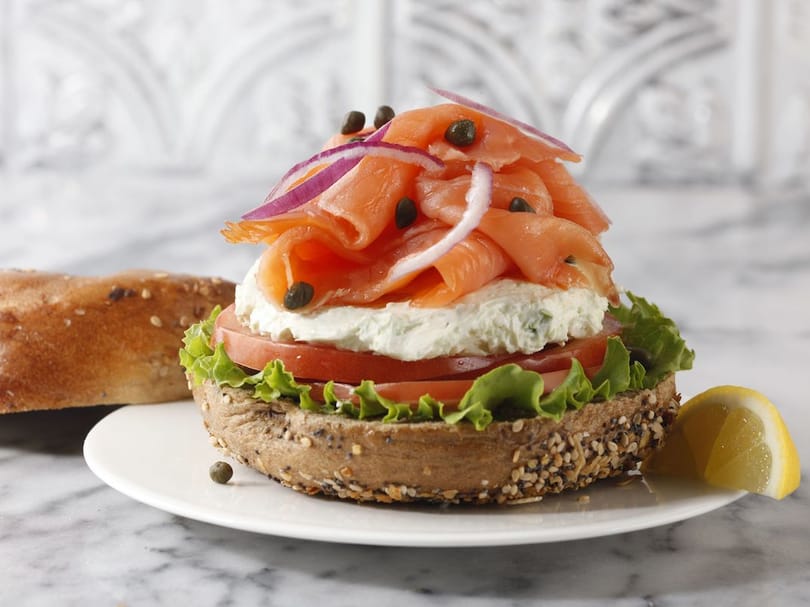
bagel from Ess-A-Bagel in New York City
A generously loaded New York bagel. Credit: Ess-A-Bagel

The bagel: boiled, baked and never toasted

What separates a real New York bagel from a round bread roll is the boil. The dough is shaped, rested, dropped briefly into boiling water and then baked, which gives it a glossy, slightly crackly crust and a dense, chewy interior. Jewish immigrants from Eastern Europe brought the bagel to the Lower East Side in the late 1800s, and for decades bagel bakers were so specialized that they had their own union.

New Yorkers argue about everything, and bagels are no exception, but a few rules are broadly agreed. A fresh bagel doesn't need toasting. "Everything" is a flavor, and a great one. And a "schmear" means a generous layer of cream cheese, plain or mixed with scallion, vegetables or smoked salmon.

The full appetizing experience

For the classic bagel with lox, visit an appetizing shop, the Jewish-deli tradition devoted to smoked and cured fish, cream cheese and other foods eaten with bagels. Russ & Daughters on East Houston Street has been selling smoked salmon, sturgeon and herring since 1914 and is the most famous of them. Order a bagel with nova, cream cheese, capers, red onion and tomato, and you'll understand the fuss.

Pastrami on rye: the deli sandwich of legend

Pastrami is beef brisket or navel that has been cured, rubbed with black pepper and coriander, smoked and then steamed until it practically falls apart. It came to New York with Romanian Jewish immigrants and became the centerpiece of the Jewish deli, piled high on rye bread with a smear of spicy brown mustard. Never mayonnaise.

Katz's Delicatessen, founded on the Lower East Side in 1888 and long a fixture at the corner of Houston and Ludlow Streets, is the city's most famous deli. During World War II its sign urged customers to "send a salami to your boy in the army," and in 1989 it became a film location for one of the most quoted scenes in When Harry Met Sally. The meat is still hand-carved to order.

Local tip: at Katz's you're handed a paper ticket at the door. Hold on to it: the counter staff mark it as you order, and you hand it in when you leave. Tip the carver and you'll usually be offered a taste of pastrami while your sandwich is cut. One sandwich easily feeds two people.

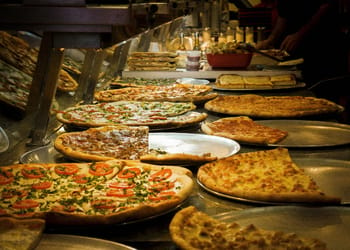
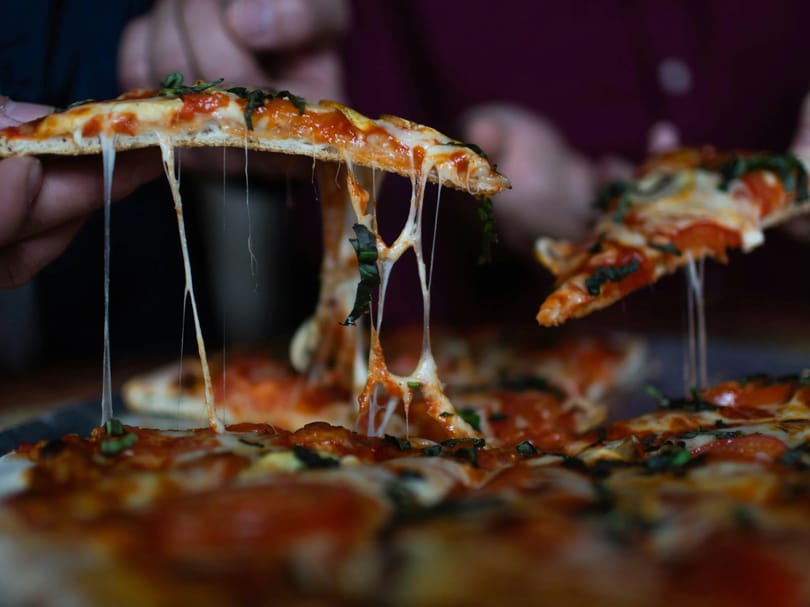
person picking sliced pizza
The New York slice: wide, thin and made for folding

The slice: fold it and go

A New York slice is cut from a large, thin pie with a crisp but pliable crust, a bright tomato sauce and a layer of low-moisture mozzarella. It's designed to be eaten standing up. Fold it lengthwise down the middle so the tip doesn't droop, and you've got a portable lunch.

The city's pizza story starts in Little Italy, where Lombardi's on Spring Street is often described as America's first licensed pizzeria, dating its license to 1905. Today you'll find everything from old-school slice counters to wood-fired Neapolitan spots and thick Sicilian squares. We break down every style in our field guide to New York pizza.

New York cheesecake: dense, rich and unapologetic

New York-style cheesecake is built on cream cheese, which makes it denser, smoother and richer than the lighter ricotta-based cheesecakes of Italy. The classic version is tall and plain, with a thin crust and a slightly tangy flavor, and it needs no fruit topping at all.

Here's a fun piece of trivia: the cream cheese brand named Philadelphia was actually developed in New York State in the 1870s, and was named after Philadelphia only because the city had a reputation for fine dairy. For a slice with history, head to Junior's in Downtown Brooklyn, which has been serving its famous cheesecake since 1950, and now has outposts near Times Square too.

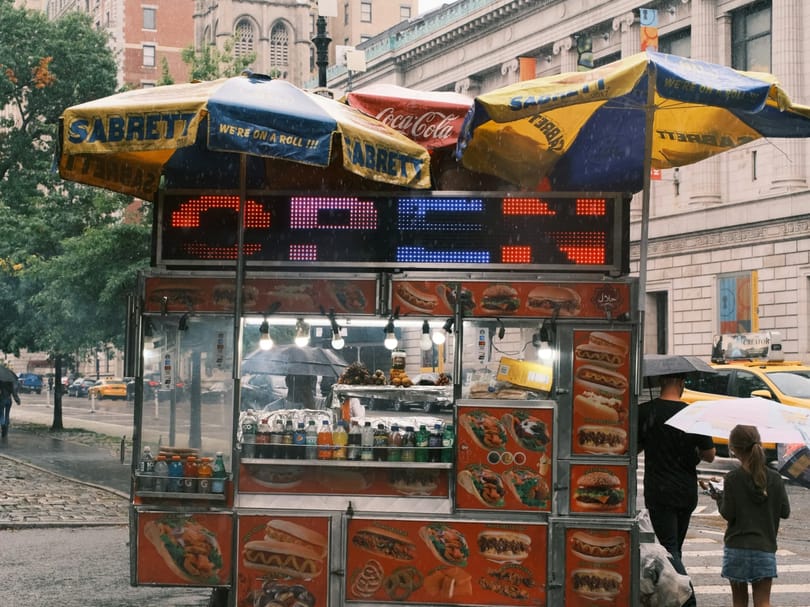
A food cart with umbrellas on a city street in NYC
Street carts feed the city from early morning to late at night

The halal cart: chicken over rice

If there's a dish that defines modern New York street food, it's the halal platter: chopped chicken or lamb gyro over yellow rice, with lettuce, pita, a cooling white sauce and a fiery red hot sauce. Carts serving it are found on corners all over Manhattan, and many run late into the night.

The most famous is The Halal Guys, which began as a hot dog cart at 53rd Street and Sixth Avenue in 1990. Its founders noticed that many Muslim taxi drivers were looking for a quick halal meal, switched their menu, and created a style that's now copied across the city and beyond.

How to order: ask for "chicken over rice, white sauce and hot sauce", and go easy on the hot sauce the first time. It's genuinely spicy.

The egg cream: no egg, no cream

New York's most confusing drink contains neither of the things in its name. An egg cream is simply cold milk, chocolate syrup and a hard blast of seltzer, stirred until a tall white foam forms on top. It was a staple of Jewish soda fountains and candy stores in Brooklyn and the Lower East Side from the early 1900s, and nobody fully agrees on where the name came from.

Purists insist on Fox's U-Bet chocolate syrup, made in Brooklyn, and on seltzer that's as fizzy as possible. You'll find egg creams at old-fashioned luncheonettes and some delis. Ray's Candy Store on Avenue A in the East Village has been making them for decades.

The black-and-white cookie

Not really a cookie at all, the black-and-white is a soft, cake-like round frosted half with vanilla fondant and half with chocolate. It's sold in delis, bakeries and bodegas all over the city. Seinfeld fans know it as a symbol of racial harmony, thanks to a 1994 episode in which Jerry declares that the key is to "look to the cookie." Local advice: take your first bite right down the middle, so you get both sides at once.

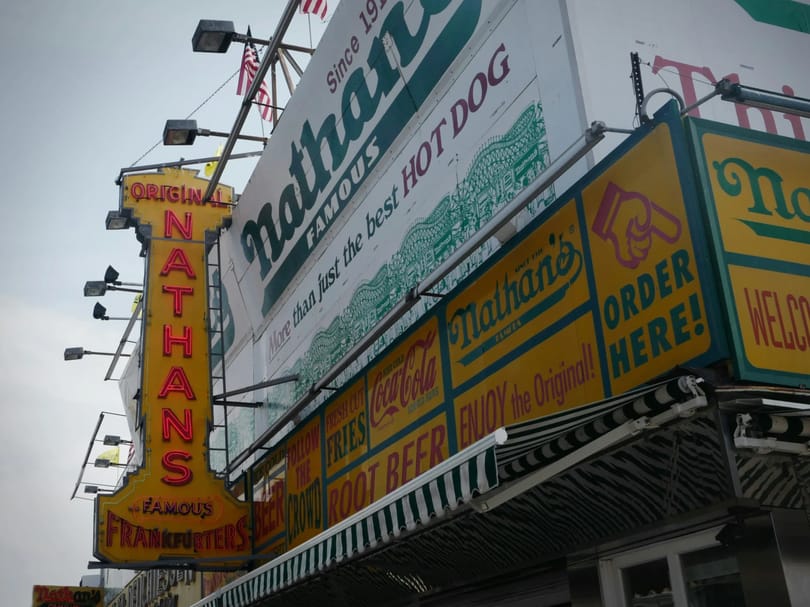
Nathan's Famous Hot Dogs in Coney Island, New York
Nathan's Famous in Coney Island, serving hot dogs since 1916

Bonus: the Coney Island hot dog

No list of New York foods is complete without the hot dog. Nathan Handwerker opened his stand on Coney Island in 1916, and Nathan's Famous still anchors the boardwalk, hosting its famous hot dog eating contest every Fourth of July. Closer to Midtown, the humble "dirty water dog" from a street cart, topped with mustard, sauerkraut or onions in red sauce, is a rite of passage.

Your New York food bucket list

  • A fresh bagel with a schmear, untoasted
  • Bagel and lox from an appetizing shop
  • Pastrami on rye with spicy brown mustard
  • A folded slice from a neighborhood counter
  • A plain slice of New York cheesecake
  • Chicken over rice from a halal cart, white sauce and hot sauce
  • An egg cream, stirred until it foams
  • A black-and-white cookie, bitten down the middle
  • A hot dog on or near the Coney Island boardwalk

Eat your way through New York with us

The best way to understand these foods is to taste them in the neighborhoods where they were born. Our SoHo, Little Italy and Chinatown Walking Tour explores the streets where so many of the city's immigrant food traditions began. Cross the river on our Guided DUMBO Foodie Experience, or roll up your sleeves at our Pizza-Making Workshop and Dinner.

New York Experience is run by ExperienceFirst, a New York tour company founded in 2009.

New York food FAQs

Pizza and bagels are the two dishes most people associate with New York, followed closely by pastrami sandwiches, cheesecake and street-cart food like halal platters and hot dogs.
They're boiled briefly before baking, which creates a shiny, chewy crust and a dense interior. Many New Yorkers also credit the city's soft tap water, though bakers debate how much it really matters.
No. A classic egg cream is just milk, chocolate syrup and seltzer. The origin of the name is still debated.
Chicken over rice with white sauce and a little hot sauce is the classic order. Lamb gyro or a combination of both is also popular.
Many carts and small counters now take cards, but not all. Carrying a little cash is still a good idea.