All posts

September 23, 2026

The Race to the Sky: How New York Invented the Skyscraper Skyline

Chicago can fairly claim the first steel-framed skyscraper. But New York turned the skyscraper into a spectacle, a status symbol and, eventually, a skyline so recognizable that its silhouette alone says “America.” The city’s towers weren’t built by planners working to a grand design. They were built by bankers, retailers and car manufacturers trying to outdo one another, and by a zoning law that accidentally gave them their shape.

Here’s how it happened, and where to stand to see each chapter of the story for yourself.

Before the race: elevators and the “up” problem

A building is only as tall as people are willing to climb. The breakthrough came in 1854, when Elisha Otis demonstrated his safety elevator in New York by having the hoisting rope cut while he stood on the platform, and the brake held. Within a couple of decades, office buildings with passenger elevators were rising along lower Broadway, and the city’s tallest structure, the spire of Trinity Church, was about to be overtaken for good.

By the turn of the century, steel frames freed walls from carrying the building’s weight, and developers realized that height itself was advertising. A tower visible from across the harbor was a billboard nobody could ignore.
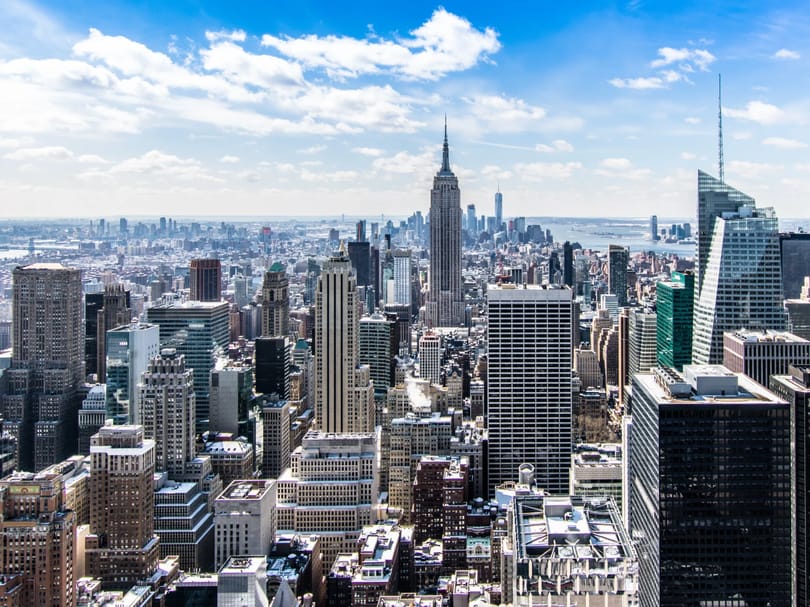
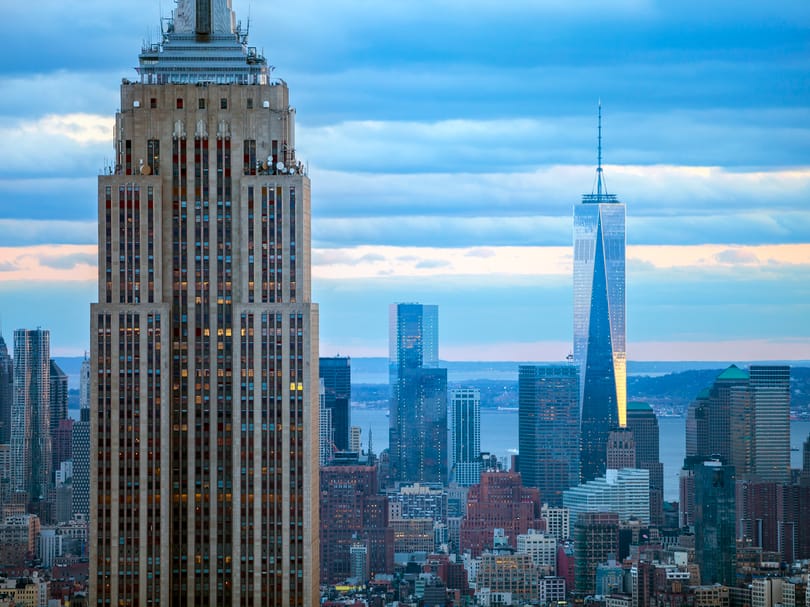
New York City skyline with skyscrapers
New York’s skyline is the product of more than a century of competition, commerce and zoning.

The Cathedral of Commerce

The first New York tower to capture the world’s imagination belonged to a man who sold things for five and ten cents. Frank W. Woolworth hired architect Cass Gilbert to design a headquarters on Broadway opposite City Hall Park, and he famously paid for it in cash. When the Woolworth Building opened in 1913 at 792 feet, it was the tallest building in the world, and it held that title until 1930.

Gilbert dressed the steel frame in cream-colored terra cotta with Gothic pinnacles, arches and gargoyles, and at the opening a clergyman called it a “Cathedral of Commerce.” The name stuck. President Woodrow Wilson pressed a button in Washington to switch on its lights for the first time. Inside, the lobby is a glittering mosaic vault, and among the carved figures are a caricature of Woolworth counting coins and Gilbert cradling a model of the building. The lobby is not open for casual visits, so book a lobby tour if you want to see it.

The shadow that changed the rules

In 1915 the Equitable Building opened at 120 Broadway: a massive, straight-sided block of around 40 stories that rose directly from the sidewalk and cast a noon shadow across several blocks. Neighbors lost light, air and rental value, and public anger helped push through the 1916 Zoning Resolution, the first comprehensive zoning law in the United States.

The law didn’t cap height. Instead, it required buildings to step back from the street as they rose, according to a formula based on the width of the street, and allowed a tower of unlimited height over a portion of the lot. The result was the “wedding cake” or ziggurat profile that defines Art Deco New York. Once you know to look for them, the setbacks are everywhere in Midtown.

1929: The secret spire

The most dramatic chapter in the story played out in the months around the 1929 stock market crash, between two former business partners.

Downtown, architect H. Craig Severance was racing to finish the Bank of Manhattan Trust Building at 40 Wall Street. In Midtown, his former partner William Van Alen was designing a headquarters for automaker Walter Chrysler at Lexington Avenue and 42nd Street. Both wanted the title of world’s tallest. Severance, believing he had the edge, added height to his design and topped out at 927 feet.

Van Alen had a surprise. Inside the Chrysler Building’s crown, his team had quietly assembled a slender steel spire, known as the vertex, some 185 feet long. In October 1929 it was hoisted up through the top of the building and bolted into place in about an hour and a half. The Chrysler Building suddenly stood at 1,046 feet, the tallest structure in the world and the first to pass 1,000 feet. Severance could only watch.

Look closely at the Chrysler Building and you’ll see it’s a love letter to the automobile: stainless-steel eagle heads project from the corners, and a frieze of stylized hubcaps and fenders wraps around one of the lower setbacks.

Where to see it

For the best street-level view of the Chrysler Building’s crown, stand at the corner of Lexington Avenue and East 44th Street and look south, or head up to SUMMIT One Vanderbilt, just across the street, where the spire looks close enough to touch. Step into the Chrysler lobby on a weekday, if it’s open, to see its red marble, amber lighting and ceiling mural celebrating transportation and human endeavor.

Empire State Building
The Empire State Building rose in roughly 13 months during the early Depression.

The Empire State Building: 13 months to the top

The Chrysler Building’s reign lasted less than a year. On Fifth Avenue at 34th Street, a group led by former New York governor Al Smith and backed by financier John J. Raskob was building something taller still. Designed by Shreve, Lamb & Harmon, the Empire State Building went up at astonishing speed: steelwork began in March 1930, and the building opened on May 1, 1931, roughly 13 months later. At its peak the frame rose by several stories a week.

At 1,250 feet to its roof, it was the world’s tallest building for nearly 40 years. Its builders even topped it with a mast intended for mooring airships, an idea that proved wildly impractical at that height and in Manhattan’s winds. Opening in the depths of the Depression, the building struggled to find tenants at first and was mocked as the “Empty State Building,” but its observation deck helped keep it afloat.

Rockefeller Center: a city within the city

While others built single towers, John D. Rockefeller Jr. built a district. Rockefeller Center, constructed through the 1930s, grouped a series of limestone Art Deco buildings around plazas, sunken gardens and a private street, with the 70-story RCA Building (now 30 Rockefeller Plaza) at its heart. It was one of the largest private building projects of the Depression era and a new idea: a skyscraper complex designed for people at street level as much as for the skyline.

Its public art program, from Lee Lawrie’s Atlas to Paul Manship’s Prometheus, turned the complex into an open-air gallery. Our Rockefeller Center tour unpacks the symbolism, then heads up to Top of the Rock for the payoff view.

Glass boxes and the next rulebook

After World War II, the fashion flipped from ornament to minimalism. Lever House (1952) and Mies van der Rohe’s bronze-and-glass Seagram Building (1958) on Park Avenue introduced the sleek International Style tower set back behind an open plaza. The city liked the plazas so much that its 1961 zoning overhaul rewarded developers with extra floor area in exchange for public space, reshaping the skyline once again. The World Trade Center’s Twin Towers, completed in the early 1970s, finally took the city’s height record from the Empire State Building.

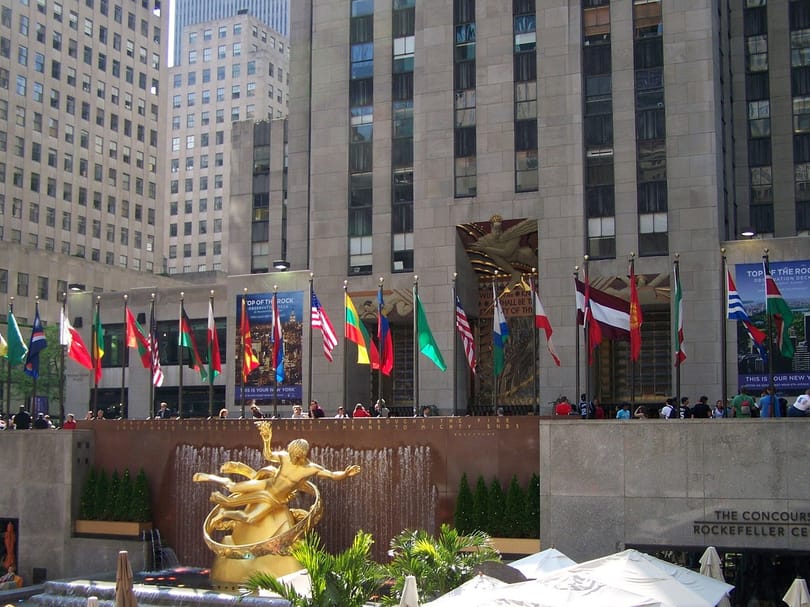
Flags at Rockefeller Center in New York
The flags of Rockefeller Plaza, at the center of John D. Rockefeller Jr.’s Art Deco complex.

Today’s race: supertalls and One Vanderbilt

The 21st century brought a new chapter. One World Trade Center reached a symbolic 1,776 feet in 2014, and a wave of “supertall” residential towers transformed the southern edge of Central Park, including impossibly slender pencil towers along West 57th Street that engineers can build only thanks to high-strength concrete and massive tuned dampers to keep them from swaying.

In Midtown East, One Vanderbilt, designed by Kohn Pedersen Fox, opened in 2020 at 1,401 feet beside Grand Central Terminal. Its tapering, faceted terra-cotta base nods to the terminal next door, and as part of the deal that allowed its height, the developer funded major transit improvements in and around Grand Central. At the top, SUMMIT One Vanderbilt opened in 2021 as a multi-level observatory of mirrored rooms and glass ledges, with a view straight across at the Chrysler Building’s spire. It’s a fitting end point: a century after the race began, you can stand in the newest tower and look directly at the old champion.

The mirrored Transcendence installation at Summit One Vanderbilt in New York
The mirrored Transcendence room at SUMMIT One Vanderbilt.

A skyscraper-spotting checklist

  • Woolworth Building (1913): Gothic terra cotta on Broadway opposite City Hall Park
  • Equitable Building (1915): the bulky block at 120 Broadway that inspired zoning
  • 40 Wall Street (1930): the downtown contender, now known as The Trump Building
  • Chrysler Building (1930): the stainless-steel spire at Lexington and 42nd
  • Empire State Building (1931): Fifth Avenue and 34th Street
  • 30 Rockefeller Plaza (1933): the Art Deco heart of Rockefeller Center
  • Seagram Building (1958): Mies van der Rohe’s bronze tower on Park Avenue
  • One Vanderbilt (2020): SUMMIT observatory beside Grand Central
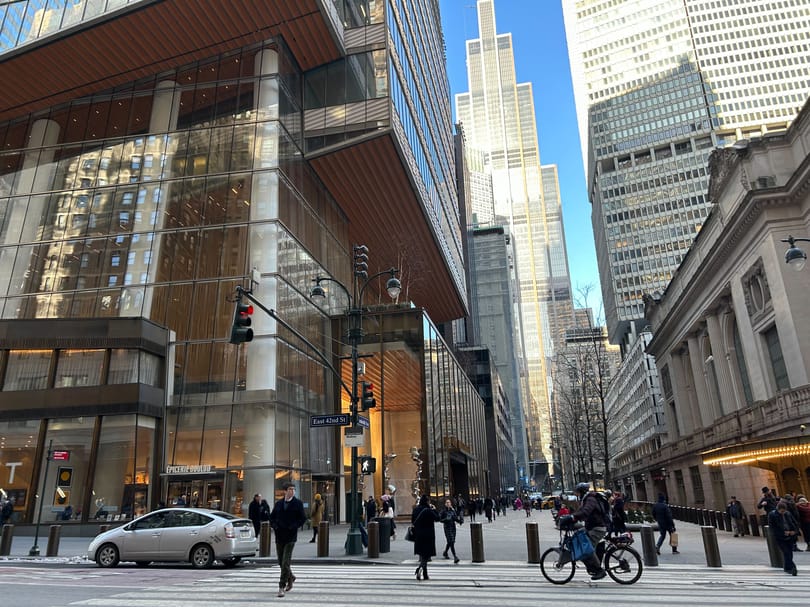
Midtown Manhattan architecture, seen from the sidewalk.

Walk the race with a guide

This story is best told on the sidewalk, craning your neck. Our Skyscrapers & Summit Guided Experience connects Grand Central, the Chrysler Building and the Midtown towers before you head up to SUMMIT One Vanderbilt to see them from above.

New York Experience is run by ExperienceFirst, a New York tour company founded in 2009. Our guides have been pointing out setbacks and secret spires for years, and they never get tired of it.

Skyscraper FAQs

There’s no single agreed answer, because definitions vary. Tall office buildings with passenger elevators appeared on lower Broadway in the 1870s, and steel-framed towers followed in the 1890s. The Woolworth Building of 1913 was the first New York tower to become the world’s tallest building.
Architect William Van Alen secretly assembled a 185-foot spire inside the building’s crown and raised it into place in October 1929, taking the Chrysler Building to 1,046 feet, well above 40 Wall Street’s 927 feet.
Steelwork began in March 1930 and the building opened on May 1, 1931, about 13 months later.
The 1916 Zoning Resolution required tall buildings to step back from the street as they rose, to let light and air reach the sidewalks. That rule created the classic wedding-cake shape of Art Deco towers.
One World Trade Center, at 1,776 feet including its spire, is the tallest building in New York and in the Western Hemisphere.
SUMMIT One Vanderbilt, directly across 42nd Street from the Chrysler Building, offers one of the closest high-level views of its spire.