All posts

September 23, 2026

Walking the High Line: A Mile of Rail History Above Manhattan

Every day, thousands of people stroll 30 feet above Manhattan’s West Side on a ribbon of wildflowers, birch trees and weathered steel rails. Most of them are enjoying the view. Far fewer realize they’re walking on one of the most unlikely rescue stories in American city planning: a freight railroad that was built to stop people dying in the street, abandoned for a quarter of a century, and very nearly torn down before two neighbors decided it deserved a second life.

The High Line runs for roughly a mile and a half, from Gansevoort Street in the Meatpacking District up through Chelsea to West 34th Street at Hudson Yards. It’s free, it’s open year-round, and it’s best understood if you know what you’re looking at. Here’s the story, section by section, plus the practical tips we give our own guests.

Before the High Line: “Death Avenue” and the West Side Cowboys

In the mid-1800s the New York Central Railroad ran freight trains right down the middle of Tenth and Eleventh Avenues, at street level, hauling meat, milk and produce to the warehouses and piers of the Lower West Side. The trains shared the road with horses, carts, pushcarts and pedestrians, and the results were grim enough that Tenth Avenue earned the nickname “Death Avenue.”

The city’s solution, for decades, was remarkably low-tech. The railroad employed the West Side Cowboys: men on horseback who rode ahead of the locomotives waving red flags (and red lanterns at night) to clear the way. It sounds like something from a Western, but the cowboys were a real fixture of Manhattan street life into the early 1940s, long after the elevated line had started carrying most of the traffic.
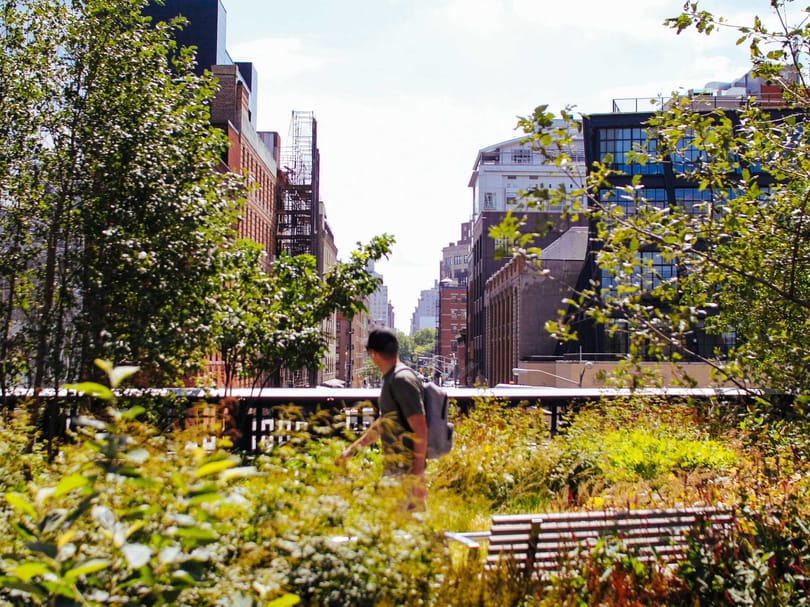
On the High Line looking down a Manhattan street
The High Line still threads between buildings rather than running over the avenues, exactly as its 1930s engineers intended.

1934: A railroad through the middle of the block

After years of public pressure, the city, the state and the New York Central agreed on the West Side Improvement Project, a huge public works scheme that lifted the freight tracks off the street. The elevated line opened in 1934 and ran from 34th Street down to a terminal at St. John’s Park near Spring Street.

What made the design clever, and what still makes the park feel so unusual, is that it mostly doesn’t follow the avenues. Engineers routed the viaduct through the middle of the blocks so that trains could roll straight into the upper floors of factories and warehouses. Goods could be unloaded indoors without ever touching the street. As you walk, look for the places where the structure passes through buildings rather than beside them; those are the fingerprints of that original purpose.

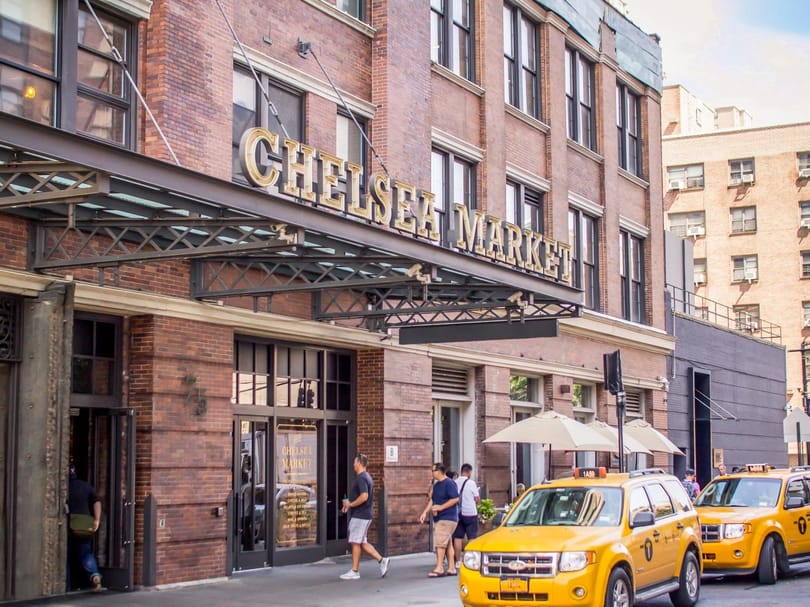
The most famous customer was the National Biscuit Company. Its sprawling bakery complex between Ninth and Tenth Avenues, where the Oreo cookie was first produced in 1912, was served directly by the line. Today that complex is Chelsea Market.

Decline, a turkey delivery and a near-demolition

The interstate trucking boom after World War II slowly killed the High Line’s business. The southernmost section was demolished in the 1960s, and in 1980 the last train made its run, reportedly carrying three carloads of frozen turkeys. Then the line simply sat there.

Left alone for years, the tracks did something nobody planned: they grew a meadow. Wind-blown seeds took root in the gravel ballast, and a wild, self-seeded landscape of grasses, wildflowers and small trees spread along the rusting rails. By the 1990s, property owners below were lobbying to have the whole thing torn down, and demolition looked like a formality.

Two neighbors and the Friends of the High Line

In 1999, two local residents, Joshua David and Robert Hammond, met at a community meeting about the structure’s future and discovered they were the only people in the room who wanted to save it. They founded Friends of the High Line, the nonprofit that still operates the park today in partnership with the City of New York.

It was a long campaign. Photographs of the overgrown tracks helped the public see what the pair saw, and the city eventually swung behind the idea of an elevated park. The railroad’s owner donated the structure, and a design team was selected: landscape architects James Corner Field Operations, architects Diller Scofidio + Renfro, and Dutch garden designer Piet Oudolf. The first section, from Gansevoort Street to West 20th Street, opened in June 2009. The second, up to West 30th Street, followed in 2011, and the section wrapping around the rail yards opened in 2014.

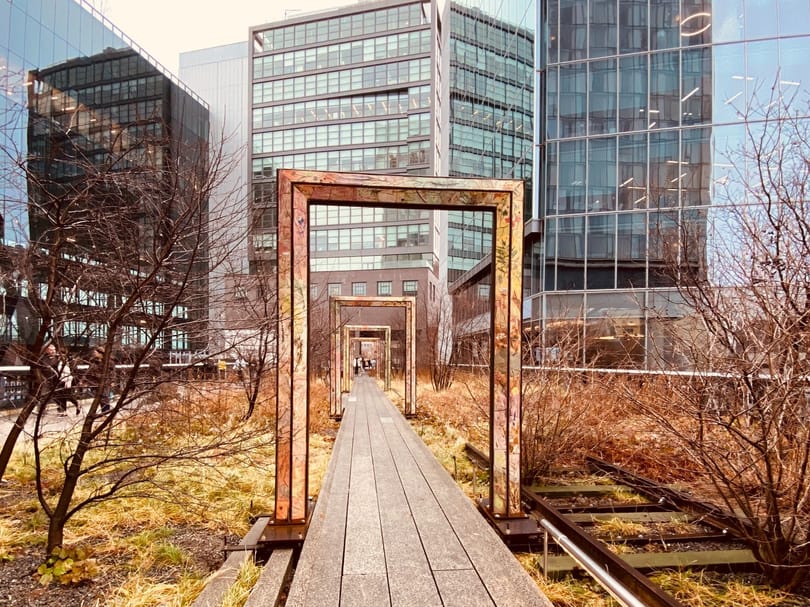
A view down the High Line park in NYC
Concrete planks taper into the planting beds so the path and the garden seem to grow into each other.

How to read the design

The designers had a simple guiding idea: keep the strange, slow, overgrown character that made people fall in love with the abandoned line. A few details to look for:

  • The planks. The walkway is made of long precast concrete planks that taper at the ends and comb into the planting beds, so paths and plants mingle rather than meeting at a hard curb.
  • The rails. Original tracks were lifted, catalogued and reinstalled in many places, often running through the plantings as if trains had only just stopped.
  • The peel-up benches. Several benches look as if a plank has curled up out of the deck to form a seat.
  • The planting. Oudolf chose hardy grasses, perennials, shrubs and trees, many of them native, that echo the self-seeded meadow. The garden is designed to look good in every season, including the tawny seed heads of winter.

Walking it south to north: what you’ll pass

You can start at either end, but walking north from Gansevoort Street gives the story a satisfying arc: you begin among old warehouses and finish among glass towers that didn’t exist a decade ago.

Gansevoort Street and the Whitney

The southern entrance sits beside the Whitney Museum of American Art, whose Renzo Piano–designed building opened here in 2015. Its outdoor terraces look back at the start of the High Line. A few blocks further north, The Standard hotel straddles the park on huge concrete legs.

Chelsea Market (around West 15th–16th Streets)

Near 15th Street the line passes over the former Nabisco complex. Take the stairs down for a snack stop in Chelsea Market, where the brick arcades, exposed pipes and old factory fittings have been kept on purpose. Nearby, the semi-enclosed Chelsea Market Passage is a pleasant, sheltered stretch on a hot or drizzly day.

Tenth Avenue Square

At West 17th Street, stepped wooden seating descends toward a glass window framing the traffic on Tenth Avenue below. It’s one of the best people-watching (and car-watching) seats in the city, and a reminder that you’re standing on a bridge over the very avenue this line was built to make safe.

Little Island detour

From the southern end, it’s a short walk west to Little Island, the park on concrete “tulip” pilings in the Hudson River at West 13th Street, which opened in 2021. Pairing the two makes a great half-day of elevated, unusual green space.

The West 20s: Chelsea galleries and the Flyover

Between roughly 20th and 30th Streets the park narrows and widens as it passes blocks packed with contemporary art galleries at street level. Look for the Flyover, where the walkway rises above the planting to put you among the tree canopy, and the 23rd Street Lawn, one of the few places you can actually sit on grass up here.

Chelsea Market sign in NYC
Chelsea Market occupies the former Nabisco bakery that the High Line once served directly.

The Spur and Hudson Yards

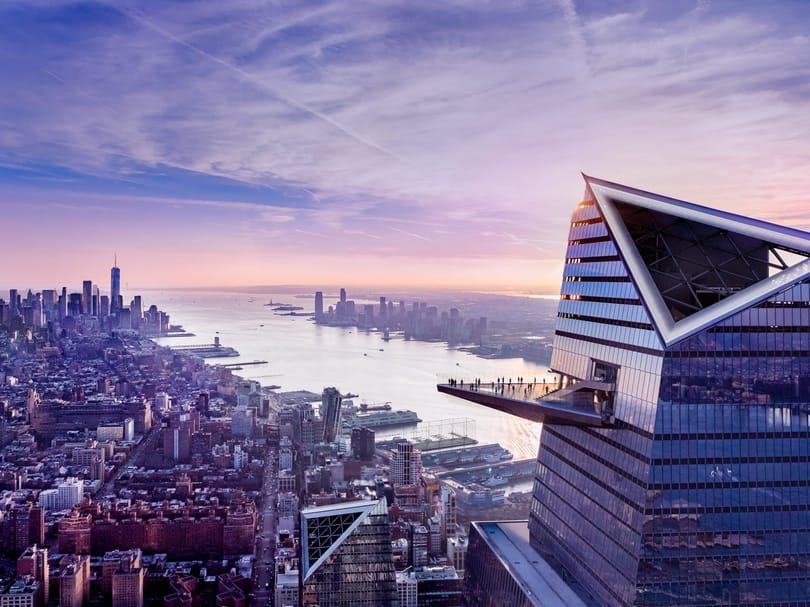
At 30th Street the line bends west around the rail yards, and the scenery changes completely. The Spur, which opened in 2019 over Tenth Avenue, hosts a rotating large-scale public art commission on a tall plinth. Then the towers of Hudson Yards close in: the honeycomb-like Vessel sculpture by Heatherwick Studio, and Edge, the outdoor sky deck that juts out from the side of 30 Hudson Yards with a glass floor about 100 stories up. If you’re considering Edge, check current ticket options and timed-entry slots before you go, especially around sunset. Our Private Hudson Yards Tour picks up the story where the High Line ends.

The northern end curves around the still-active rail yards toward West 34th Street, where you can see commuter trains resting below, a fitting final glimpse of the railroad world the High Line came from.

Edge outdoor skydeck, New York City
Edge, the sky deck at Hudson Yards, is the dramatic finale if you walk the High Line north.

Practical tips for visiting the High Line

The High Line is free and doesn’t require a reservation, but a little planning makes a big difference. Opening hours change with the seasons, so check the current schedule on the official High Line website before you go.

High Line checklist

  • Go early on weekdays: the first hour after opening is the calmest, especially in summer.
  • Allow 1 to 1.5 hours if you want to stop, read the signs and take photos; walking straight through takes about 30 minutes.
  • Use an elevator entrance if you need step-free access; several entrances along the route have elevators.
  • Bring water in summer: there is little shade on some stretches.
  • Don’t skip winter: the dried grasses and seed heads are part of the design, and crowds are thin.
  • Stay on the paths; the planting beds are fragile gardens, not lawns.
  • Pair it with Chelsea Market for food and Hudson Yards for a view from above.
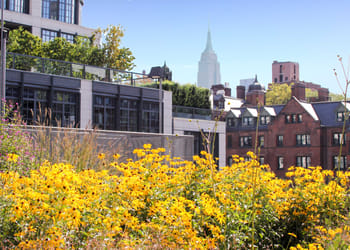
A view of the Empire State Building from the High Line
Watch for framed glimpses of Midtown, including the Empire State Building, as you walk north.

See it with a guide

The High Line is easy to walk on your own, but it’s also easy to walk the whole length without noticing the old loading docks, the rerouted rails or the stories behind the neighborhoods below. On our Private High Line and Chelsea Walking Tour, your own local guide connects the park to the Meatpacking District, Chelsea Market and the galleries, and points out the details most visitors walk straight past.

New York Experience is run by ExperienceFirst, a New York tour company founded in 2009, so these are streets our guides know well.

High Line FAQs

About 1.45 miles (roughly 2.3 km), running from Gansevoort Street in the Meatpacking District to West 34th Street between Tenth and Twelfth Avenues.
Yes. There is no admission fee and no reservation is needed for general visits. Opening hours vary by season, so check the official schedule before you go.
Either end works. Starting at Gansevoort Street and walking north lets you finish at Hudson Yards, where you can visit Edge or the Vessel; starting at 34th Street lets you finish near Chelsea Market, the Whitney and Little Island.
The first section opened in June 2009, the second in 2011 and the final rail yards section in 2014. The Spur at 30th Street and Tenth Avenue followed in 2019.
Yes. Several entrances along the route have elevators, and the walkway itself is step-free, though it can be narrow and busy at peak times.
It was built in the early 1930s to lift freight trains off Tenth and Eleventh Avenues, where street-level trains had caused so many accidents that Tenth Avenue was nicknamed Death Avenue.